
Integration in the tube and pipe industry spans multiple configurations, from raw material linkage and manufacturing control to system-level supply and, in specific cases, turnkey execution. These approaches are not universal, but adopted selectively where application requirements and project structures demand greater coordination and accountability, and may see wider adoption in similar segments as such requirements evolve.
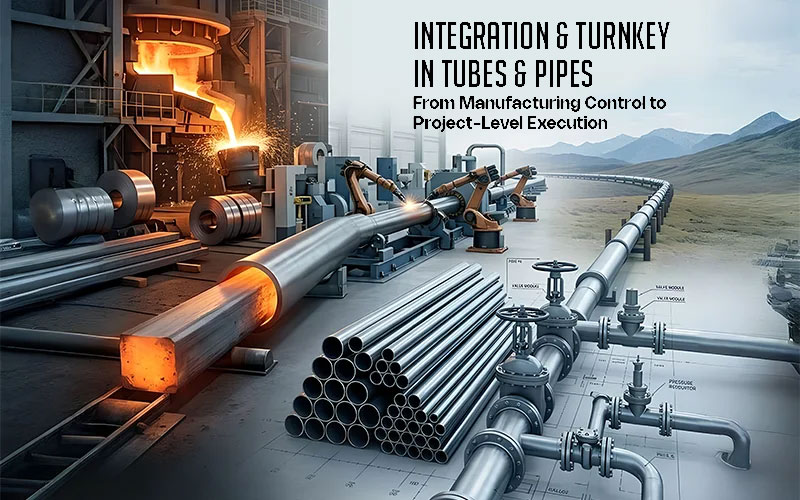
From raw material to project execution, integration in tubes and pipes take multiple forms across value chain.
In segments of the Indian tube and pipe industry, particularly among manufacturers serving infrastructure and export-driven applications, how capabilities are being organised within firms is evident. Rather than operating as standalone product suppliers, some companies are structuring their operations to cover multiple stages of the value chain, ranging from manufacturing and processing to quality assurance and delivery. This is not uniform across the industry, nor is it a default model, but it is evident among players serving requirements where consistency, compliance, and execution responsibility extend beyond the product itself. It is within this subset of manufacturers that integrated manufacturing and end-to-end capability begin to emerge as a defining operational approach.
From Products to Systems
Integration, where it exists among Indian tube and pipe manufacturers, does not present itself as a uniform manufacturing expansion, but as a shift in how offerings are structured for specific applications. In certain cases, this takes the form of extending beyond pipe production into associated components or services, while in others it reflects tighter control over multiple stages of manufacturing to ensure consistency and compliance.
“Today, we have positioned ourselves to support our buyers with complete stainless steel piping and tubing solutions,” says Rahul Gujar, President & Business Head – SS Business, Jindal SAW Limited. A company like Jindal SAW, whose stainless steel portfolio spans seamless and welded tubes, fittings, and flanges across industries, illustrates precisely this, where the claim to complete solutions is backed by the operational depth to deliver them across multiple stages.
A similar structuring of capabilities is visible among companies such as APL Apollo Tubes, where downstream processing and application-linked offerings extend beyond basic tube production, and Welspun Corp, where integration spans plate processing, pipe manufacturing, and coating for line pipe applications.
For instance, MAN Industries (India) Limited refers to its capability in delivering “integrated, end-to-end pipeline solutions,” where pipe manufacturing is combined with coating and project-linked execution requirements. “Globally, customers increasingly look to India for turnkey pipeline solutions encompassing pipe manufacturing, coating and execution support,” explains Nikhil Mansukhani, Managing Director, MAN Industries (India) Limited. Here, integration is aligned with the expectations of large infrastructure projects, where procurement and execution are closely linked.
A different configuration is visible in Chandranchal Enterprise Pvt. Ltd., where the integration extends across product categories, including pipes, fittings, valves, and seals, positioned as a single-system offering for water infrastructure. Pawan Kumar Kejriwal, CMD, Chandranchal Enterprise Pvt. Limited, describes this approach as that of “a comprehensive, single-window solution provider for drinking water infrastructure.”
In contrast, companies such as Goodluck India Ltd. and Mangalam Worldwide Limited reflect integration primarily within manufacturing operations. Their emphasis remains on controlling multiple stages of production, across product lines and quality systems, rather than extending into system-level execution. This form of integration is less visible at the project interface but is linked to consistency in supply, adherence to standards, and repeatability across export markets.
These variations indicate that integration, where present, is not a singular model but a set of configurations shaped by application, product category, and market interface. The distinction between system-level integration and manufacturing-level integration becomes important in understanding how different companies interpret and deploy this capability.
What Integration Looks Like on the Ground
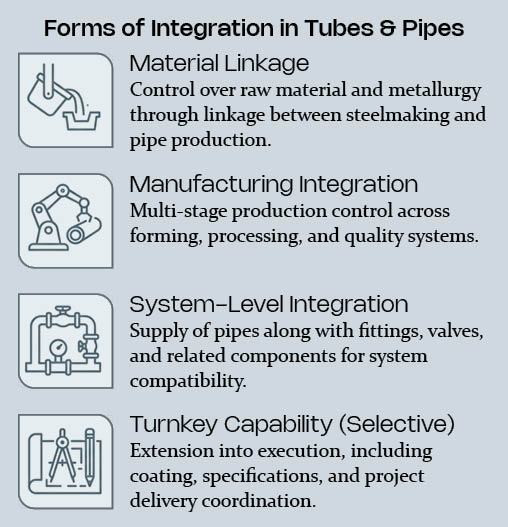
The configurations described earlier indicate that integration, where present, takes more than one form, and the distinction between these forms is necessary to avoid treating it as a single capability. Broadly, distinct patterns are observable among the companies, including integration across raw material linkage, manufacturing processes, downstream processing, and system-level delivery.
In the seamless and high-performance segment, companies such as Maharashtra Seamless Limited reflect integration through linkage between steelmaking and pipe production, enabling control over material properties and consistency across applications. A comparable approach is visible in Ratnamani Metals & Tubes, where integration extends from tube and pipe manufacturing across material categories into downstream stages such as coating and induction bending, enabling the company to meet application-specific compliance and finishing requirements in sectors such as oil and gas and process industries.
In companies such as Goodluck India Ltd. and Mangalam Worldwide Limited, integration is primarily internal to manufacturing. It involves control over multiple stages of production, product range expansion, and alignment of processing and quality systems. Goodluck India Ltd. reflects this through integrated manufacturing capabilities spanning multiple product categories, “including ERW, CDW/DOM, cylinder and hydraulic tubes, forgings, flanges, precision tubes, structural steel, and UL-certified galvanized EMT and RIGID conduits,” indicating control across a broad production and processing range. This form does not necessarily extend to project execution, but it enables consistency across batches, adherence to international standards, and flexibility in meeting varied specifications across export markets. A similar emphasis is visible in Mangalam Worldwide Limited, described as a “fully integrated stainless steel” operation, where process discipline and traceability are central to performance.
A different approach is visible in MAN Industries (India) Limited and Chandranchal Enterprise Pvt. Ltd., where integration extends beyond manufacturing into system-level delivery. Here, the offering includes not only the pipe but also associated components or services, such as coatings, fittings, valves, or execution-linked support, aligned with project requirements. In such cases, integration is linked to reducing interface risks and ensuring compatibility across the installed system.
These forms are not interchangeable. Manufacturing-level integration is oriented toward process control and product consistency, while system-level integration is oriented toward project execution and end-use performance, with additional variations emerging across material linkage and downstream processing. The distinction helps explain why integration appears in different configurations across companies, depending on the applications they serve and the markets they operate in.
Buyer-Side Drivers, Not Manufacturing Expansion
Why Integration is Adopted in Specific Cases
In the cases where integration is visible, its adoption appears linked less to internal expansion and more to the way procurement and execution are structured in certain end-use segments. In project-driven environments, particularly in oil and gas pipelines and water infrastructure, procurement is often aligned with execution timelines and performance accountability rather than with standalone product supply. This places emphasis on reducing the number of interfaces involved in delivery.
For companies such as MAN Industries (India) Limited, where engagement is closely tied to EPC contractors and large-scale infrastructure projects, the ability to offer pipes along with coating, induction bending, and in-house testing aligns with this structure. Similarly, Chandranchal Enterprise Pvt. Ltd. operates in a segment where compatibility across pipes, fittings, valves, and seals is critical to system performance, making a consolidated offering functionally relevant.
This change in procurement preference from multiple vendors supplying individual components to fewer suppliers assuming broader responsibility creates conditions where integration becomes operationally useful. It is not a default requirement across all segments, but in cases where execution risk and delivery coordination are critical, the ability to consolidate these within a single supplier becomes a differentiating factor.
Where Integration Extends Into Execution
Turnkey Capability as the Next Layer of Integration
In specific project-driven contexts, integration extends beyond manufacturing and system-level supply into turnkey capability, a configuration where the manufacturer’s responsibility is no longer confined to the product but extends into the conditions of its delivery. This involves not only producing and supplying pipes or associated components, but also aligning the offering with execution requirements, such as coating, project specifications, and delivery coordination within larger infrastructure projects.
Among the companies considered, this is most explicitly articulated by MAN Industries (India) Limited, where the reference to “end-to-end pipeline solutions” indicates a scope that moves beyond manufacturing into execution-linked responsibility. Here, the relevance of turnkey capability is tied to project structures in which suppliers are expected to integrate with EPC contractors and align with overall delivery timelines and performance requirements. This transition reflects a departure in the role of the manufacturer, from supplying components to participating in the delivery framework of a project.
A related, though differently configured, form is visible in Chandranchal Enterprise Pvt. Ltd., where the supply of pipes is combined with fittings, valves, and seals as part of a consolidated system. While not described in execution terms, this configuration performs a similar function in reducing interface points and aligning supply with installation requirements.
A related configuration is observable in the ductile iron pipe segment, where companies such as Electrosteel Castings align pipe supply with fittings and system-level requirements, reflecting an approach oriented toward consolidated delivery rather than standalone product supply.
These instances indicate that turnkey capability does not emerge as a universal extension of integration, but in contexts where execution responsibility, system compatibility, and coordination across components are integral to project delivery. Where such conditions are absent, integration remains confined to manufacturing or product-level consolidation, without extending into execution. While integration is oriented toward process control, turnkey capability extends this into execution-level accountability.
Where Integration Applies, and Where It Does Not
The configurations discussed indicate that integration, while visible in specific cases, does not function as a default operating model across the tube and pipe industry. Its applicability remains closely tied to the nature of end-use segments, project structures, and the scale at which companies operate. In segments where procurement is standardised and product specifications are modular, the requirement for system-level integration or turnkey capability remains limited, and standalone manufacturing continues to be a viable and widely adopted approach.
At the same time, integration introduces its own set of operational considerations. Extending across multiple stages of production or into system-level delivery requires alignment of processes, quality systems, and supply chains, often accompanied by higher capital investment and increased coordination complexity. The ability to sustain such a model depends not only on manufacturing capability but also on consistency in execution across all integrated stages.
This results in the coexistence of different operating models within the industry. While some companies structure themselves around integrated or turnkey offerings in response to specific market requirements, others continue to operate with focused product specialisation. At the same time, as project specifications in certain segments become more complex and compliance requirements in export markets continue to tighten, elements of these integrated approaches may find wider application among manufacturers operating in similar domains. The presence of both approaches indicates that integration is not a universal direction, but one of several ways in which companies align their capabilities with the demands of particular applications and markets.
In this context, integration can be understood not as an endpoint, but as a conditional strategy adopted where project requirements or market expectations justify a broader scope of capability. Its relevance, therefore, lies not in its prevalence across the industry, but in the specific contexts in which it provides operational and commercial advantage.