
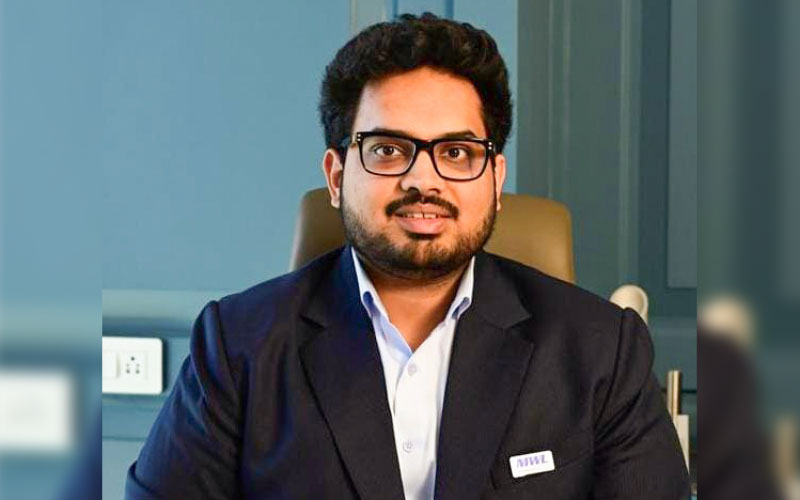
India’s tube and pipe industry continues to strengthen its global presence through advanced manufacturing and engineering capabilities. In an exclusive interview with Tube & Pipe India, Mr. Chandragupt Prakash Mangal, Managing Director, Mangalam Worldwide Limited (MWL), shares how Indian manufacturers of fully integrated stainless steel long and tubular products are building global credibility through quality consistency, process discipline, and application reliability. He discusses the evolving role of international trade platforms, insights gained from global market exposure, India’s manufacturing strengths, and how sustainability, technology collaborations, and long-term governance are shaping India’s emergence as a dependable global engineering and manufacturing hub.
Tube & Pipe India: What will you showcase at Tube Düsseldorf to highlight India’s technological capabilities and manufacturing excellence to a global audience?
Chandragupt Prakash Mangal: At Tube Düsseldorf 2026, MWL will showcase its complete range of finished tubular stainless steel products, including long and seamless tubes and pipes, with a strong focus on three key attributes: quality consistency, process discipline, and application reliability. Through these offerings, we aim to highlight how Indian manufacturers are building long-term credibility in global markets by continuously investing in advanced manufacturing processes, robust quality control systems, employee training, and digital tools that enhance traceability and process efficiency.
For us, participation is about demonstrating that Indian manufacturing is not merely cost-competitive, but globally relevant in terms of standards, reliability, and innovation. For MWL, Tube Düsseldorf is a strategic platform to present how our long-term manufacturing vision aligns with global customer expectations, demonstrating that Indian manufacturing is not merely cost-competitive, but globally relevant in terms of standards, reliability, and innovation.
TPI: International trade fairs play a crucial role in shaping industry collaborations. How do platforms like Tube Düsseldorf help Indian manufacturers connect with global markets and customers?
CGM: Platforms like Tube Düsseldorf are important for Indian manufacturers to connect with international markets. Trade fairs allow us to engage in detailed technical conversations with customers and partners, gain direct feedback on application needs, and foster trust through tangible product demonstrations. These interactions help shift the conversation beyond price, emphasizing long-term collaboration founded on quality, reliability, and mutual understanding. From a company perspective, such platforms support our vision of building enduring global partnerships, where engagement is driven by engineering depth and application understanding rather than transactional selling. For Indian manufacturers, such forums are also invaluable for benchmarking our processes against global best practices and adopting improvements that benefit the broader industry.
TPI: From your participation at Tube Düsseldorf, what key global market insights are you hoping to gain and bring back to strengthen India’s tube and pipe manufacturing ecosystem?
CGM: Exposure to international markets enables us to understand how global customers evaluate suppliers, particularly around quality assurance, traceability, sustainability, and long-term reliability. These insights guide our internal improvements and help set higher benchmarks across the Indian supply chain. For MWL, these learnings are integral to our broader vision of continuously upgrading systems, processes, and governance in line with global expectations. Staying aligned with global expectations ensures that Indian manufacturing continues to progress toward where the industry is heading, not merely where it has been.
TPI: Over the years, how have you seen India’s representation evolve at international trade fairs, and how do you contribute to strengthening India’s image as a global engineering hub?
CGM: India’s presence at international trade fairs has matured significantly. The focus has shifted from quantity to quality emphasizing standards, applications, and technological know-how. Indian manufacturers today are confident in conducting in-depth technical discussions with global counterparts. At MWL, we contribute to strengthening India’s image through consistent delivery, clear communication, and a commitment to dependable practices that foster long-term partnerships, reflecting a new generation of leadership that balances legacy strengths with modern governance and systems.
TPI: What core Indian manufacturing strengths differentiate you on the global stage? For what turnkey solutions is the world looking at India?
CGM: India stands out for its ability to combine engineering expertise with flexible, scalable manufacturing. Global customers are increasingly looking to India for end-to-end solutions from processing and finishing to testing, compliance, and sustainable operations. There is growing confidence in India’s capability to manage complete product creation reliably and at international standards, demonstrating the industry’s progress in systems, skills, and operational discipline.
TPI: Technology partnerships and acquisitions are critical today. How are Indo-global collaborations helping reinforce India’s engineering leadership?
CGM: International collaborations are vital to closing capability gaps and accelerating learning. Technology partnerships with developed countries have enhanced process efficiency, product quality, and compliance with global standards. While these collaborations complement in-house expertise, they also allow Indian manufacturers to adopt best practices, strengthen engineering capabilities, and reinforce India’s leadership in precision manufacturing over time.
TPI: Which international regions do you see as strategic growth markets, and how is India positioned as your global manufacturing base to support these expansions?
CGM: In Europe, the Middle East, and selected areas of South East Asia, markets are still strategically important due to infrastructure and industrial growth. India has a distinct advantage over other countries as an industrial manufacturing location within reach of these regions because of its ability to expand production quickly; it has a large pool of skilled workers; and the logistics and trade infrastructure is improving year after year. For us, India serves as a stable base to support global customers with consistent supply and long-term production planning.
TPI: How are cost pressures across raw materials, energy, or logistics being managed without compromising product reliability or compliance?
CGM: Cost pressures are a reality across the industry, and managing them requires better planning rather than shortcuts. The focus is on improving process efficiency, optimising material usage, and strengthening supplier coordination. At the same time, quality and compliance remain non-negotiable, as long-term customer relationships depend on reliability rather than short-term cost advantages.
TPI: How are sustainability expectations from customers or regulators translating into changes in product design, manufacturing practices, or material choices?
CGM: Growing customer and regulatory expectations regarding sustainability are changing how products are produced, not just what products get produced. This is leading manufacturers to place greater emphasis on energy efficiency, waste reduction, responsible material usage, and structured process systems that embed sustainability into day-to-day operations.
At MWL, sustainability and innovation form the foundation of our growth philosophy, reflected in ongoing efforts around energy efficiency, renewable adoption such as rooftop solar installations, waste optimisation, and a gradual shift toward higher-value, precision-engineered stainless steel products in line with responsible manufacturing practices.

India has a distinct advantage over other countries as an industrial manufacturing location within reach of these regions because of its ability to expand production quickly; it has a large pool of skilled workers; and the logistics and trade infrastructure is improving year after year.