
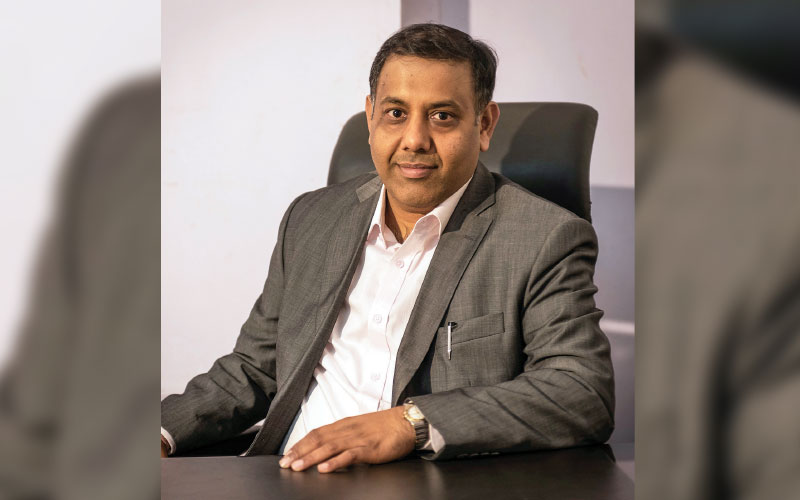
Celebrating 50 years of trust, Mangla Hoists Pvt. Ltd. positions itself as an ever evolving crane manufacturer of the industry. Calling the current decade of Indian tube and pipe industry as “the era of uncompromising reliability”, Mangla Hoists focuses on customisation for the customer. In an exclusive interview with Tube & Pipe India, Mr. Nishant Mangla, Director, Mangla Hoists Pvt. Ltd., shares his thoughts on the changing perspective of the world about the Indian tube and pipe industry, from “cheap alternative of the West, to the value alternative”. Highlighting Mangla Hoists’ alliance with INDEF for hoists and Usha Martin for wire ropes, Mr. Mangla promises exceptional quality. From being fully digitalised in operations, to deploying Condition Monitoring Systems on heavy duty cranes, Mangla Hoists aims to showcase a crane that not only lifts but “thinks” in the coming years.
Tube & Pipe India: If you had to define the current decade for the Indian tube and pipe industry in one phrase, what would it be, and why?
Nishant Mangla: The phrase would be- “The Era of Uncompromising Reliability.” I chose this phrase because the definition of “value” in India has matured. For decades, the Indian market was price-sensitive to a fault. The primary question was always, “How much does it cost?” But in this decade, the question has shifted to, “How long will it last, and how safe is it?”
The tube and pipe industry operates in a high-stakes environment. Whether it’s oil and gas pipelines or structural steel for metros, the end-use applications are critical. Consequently, the machinery used to produce these pipes—the cranes and hoists—cannot afford to fail. We are seeing a distinct shift where customers are no longer willing to risk downtime to save a small percentage on CAPEX. They want equipment that is robust, safe, and reliable. This decade belongs to manufacturers who can guarantee uptime, not just the lowest price.
TPI: Where do you see India’s manufacturing edge emerging: cost, quality, or innovation? How is your company positioning itself to lead on that front?
NM: India’s manufacturing edge is emerging at the sweet spot where global quality meets rational cost. We are no longer the “cheap” alternative to the West; we are the “value” alternative. We are producing machinery that rivals European standards in terms of metallurgy, safety features, and design life, but at a cost structure that makes sense for developing economies.
Mangla Hoists positions itself as the “safe harbor” in a chaotic market. There is a flood of low-quality imports and unorganized local players where safety is often an afterthought. We have taken the harder road of sticking to uncompromising standards.
Best-in-Class Components: We don’t just manufacture; we curate the best. Our strategic alliances with industry giants—INDEF hoists (since 1973) and Usha Martin (since 2015)—are central to this. By using genuine INDEF hoists and Usha Martin wire ropes, we ensure that the critical load-bearing components of our cranes are world-class.
Custom Engineering: We don’t believe in “one size fits all.” If a client needs a crane for a pickling bay where acid fumes are prevalent, we design for corrosion resistance. If it’s for a foundry with high heat, we design for thermal endurance. Our edge is our ability to listen to the client’s pain points and engineer a specific solution, rather than just selling a catalog product.
TPI: What is the single most disruptive technology or process upgrade you’ve implemented recently, and how has it changed your cost or performance curve?
NM: The most significant disruption for us has been the complete digital integration of our manufacturing workflow. We recently overhauled our entire internal operating system. We moved away from scattered manual processes to a unified, digital backbone that connects our sales, design, procurement, and production teams in real-time. Which further ensures the following:
Transparency: Previously, a crane was a “black box” while it was on the production floor. Now, we have granular visibility. We know exactly when the motor arrived, when the girder was cut, and when the paint shop finished its job. This transparency allows us to be honest with our customers about delivery timelines.
Inventory Optimization: In heavy engineering, dead stock is a silent killer. Our new system analyzes usage patterns and automates procurement, ensuring we have exactly what we need—no more, no less. This has improved our cash flow and reduced material wastage by nearly 15%.
Speed: We have significantly reduced the time from “Order Confirmation” to “General Arrangement Drawing (GAD) Approval.” By automating standard design parameters, our engineers can focus on the complex, custom aspects of the project, speeding up the overall delivery cycle.
“We don’t just manufacture; we curate the best. Our strategic alliances with industry giants—INDEF hoists (since 1973) and Usha Martin (since 2015)—are central to this. By using genuine INDEF hoists and Usha Martin wire ropes, we ensure that the critical load-bearing components of our cranes are world-class.”
TPI: Beyond automation, how are you leveraging data, AI, or digital twins to reimagine efficiency or product design in your plants?
NM: We are transitioning from selling “Hardware” to selling “Assurance,” and data is the key to that. We are actively deploying Condition Monitoring Systems on our heavy-duty cranes. Think of this as a health tracker for the machine. These systems monitor critical parameters like motor temperature, vibration levels, brake wear, and load cycles. This reimagines efficiency in the following ways:
Predictive vs. Reactive: Instead of waiting for a gearbox to fail and halt a client’s production line for two days, the data warns us weeks in advance that a specific component is showing signs of stress. We can schedule maintenance during a planned shutdown, ensuring zero unplanned downtime for the client.
Design Evolution: The data from these systems feeds back into our R&D. If we see that cranes in the steel tube industry are experiencing specific lateral stresses during loading, we don’t just repair it—we redesign our next generation of girders to be stronger in those specific areas. We are letting the real-world usage data design the cranes of the future.
TPI: Sustainability is now a boardroom conversation. How are you balancing decarbonisation targets with profitability and competitiveness?
NM: At Mangla Hoists, we have always believed that sustainability is essentially efficiency. A wasteful machine is bad for the planet and bad for the balance sheet. We are addressing this through:
Energy Efficient Drives: We have standardized the use of IE3 and IE4 efficiency class motors across our premium ranges. For a heavy industry running 24/7, the electricity savings from these motors are substantial. We are helping our clients lower their OPEX while meeting their green targets.
Regenerative Braking: In our high-capacity cranes, we use Variable Frequency Drives (VFDs) with regenerative units. When a heavy load is lowered, gravity generates energy. Instead of burning this off as heat (which is wasteful and damages components), our systems feed this power back into the grid.
Responsible Manufacturing: We have optimized our paint processes to reduce volatile organic compounds (VOCs) and have implemented a strict scrap recycling policy for our steel waste.
By offering these “Green Features,” we are actually making our products more competitive. Clients are realizing that a slightly higher upfront cost for an energy-efficient crane pays for itself within two years of operation.
TPI: In the metals and manufacturing sectors, recycling and material efficiency are game changers. What steps has your organisation taken to close the loop?
NM: Our greatest contribution to the circular economy is longevity. We build cranes that last 25 to 30 years. In a world of “use and throw,” we stand for “use, maintain, and upgrade.” We have a dedicated division focused on crane refurbishment and modernization.
We often visit clients who have older cranes—structures that are physically sound but electrically outdated. Instead of scrapping the entire crane (which wastes tons of steel), we retrofit them. We strip them down, inspect the welds, and install modern electrification, new hoists, and safety sensors. This “Re-Life” process effectively gives the client a brand-new crane at 60% of the cost and with 10% of the environmental footprint of manufacturing a new one. Extending the lifecycle of heavy machinery is the most effective form of recycling we can practice.
“Our edge is our ability to listen to the client’s pain points and engineer a specific solution, rather than just selling a catalog product.”
TPI: Among technology partnerships, joint R&D, and co-branding with downstream users, which form of collaboration do you find most valuable, and why?
NM: Strategic supply partnerships are the bedrock of our reputation. In the material handling business, a chain is literally only as strong as its weakest link. We cannot be experts in everything. We are experts in structural fabrication and crane engineering. But for wire ropes, we trust Usha Martin. For hoists, we trust INDEF.
These partnerships are invaluable because they allow us to offer a “Best of Breed” solution. When a customer buys a Mangla Hoist, they get the assurance of our heavy engineering combined with the R&D power of these industry titans.
It simplifies maintenance for the client (spare parts are standard and available). It guarantees safety (these brands are tested to global standards). And it builds trust, our customers know we don’t cut corners with cheap, non-branded components just to save money.
TPI: Government schemes like PLI and Gati Shakti are shaping supply chains. What tangible impact are you witnessing on ground, i.e., in demand, policy clarity, or infrastructure?
NM: PM Gati Shakti and the infrastructure push have been massive catalysts for our sector. You cannot build infrastructure without lifting equipment. Every bridge segment, every metro tunnel, every pre-cast concrete yard needs cranes. We have seen a tangible surge in demand from the infrastructure and construction sectors.
On the ground, the logistics improvements are visible. Moving a 30-meter single-piece girder from our factory in Greater Noida to a client in Southern India used to be a logistical nightmare involving weeks of delays. With the new freight corridors and improved highways, we are delivering faster and safer. Furthermore, the emphasis on “Make in India” in public sector tenders has been a great equalizer. It has given domestic manufacturers a fair platform to compete against foreign entities, proving that Indian engineering is capable of executing complex, high-value projects.
TPI: If we were to revisit this conversation at the next edition of TPF, what milestone or transformation would you want to showcase?
NM: By the next TPF, I want to showcase Mangla Hoists as a fully integrated “Smart-Lifting” partner. We are working towards a future where our cranes are an active part of the client’s “Industry 4.0” ecosystem. I envision showcasing a live demonstration of a crane that not only lifts but “thinks”—auto-correcting for sway, positioning loads with millimeter precision without operator intervention, and self-diagnosing faults.
Additionally, as we celebrate our Golden Jubilee, we are launching a special series of hoists that embody our 50-year legacy—combining the ruggedness of the past with the intelligence of the future. We want to show the world that a 50-year-old company can be as agile and innovative as a startup.
TPI: Finally, what’s the one belief or leadership principle guiding you through this phase of rapid industrial evolution?
NM: We believe that trust is the heaviest load, and we never drop it. In an era of rapid technological change, it is easy to get lost in buzzwords. But at its core, our business is about safety. When a worker stands under a 50-ton load suspended by our crane, they are trusting us with their life. That is a sacred trust.
My guiding principle is that technology must serve safety. Whether we adopt AI, new ERPs, or advanced robotics, the end goal is always the same: to build a machine that is safer, stronger, and more reliable. We are modernizing our methods, but our values remain old-school. We deliver what we promise.
“We recently overhauled our entire internal operating system. We moved away from scattered manual processes to a unified, digital backbone that connects our sales, design, procurement, and production teams in real-time.”