
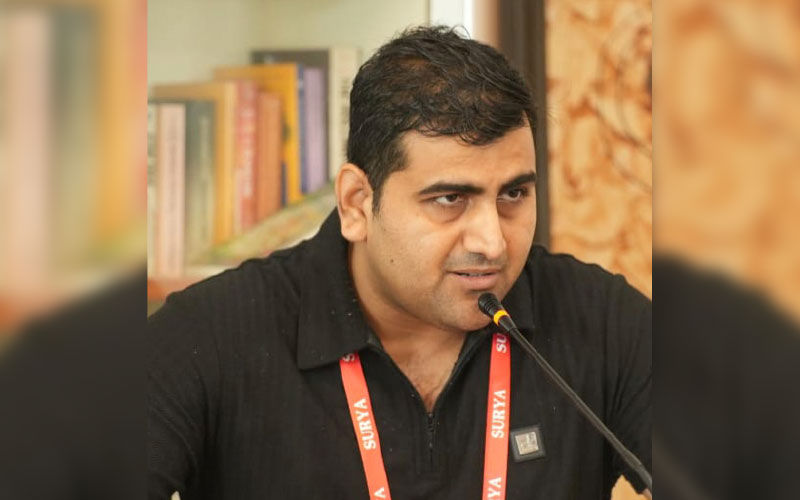
As India’s tube and pipe industry steadily moves up the global value chain, Surya Roshni Limited is redefining how Indian manufacturing is perceived worldwide. In an exclusive interaction with Tube & Pipe India, Mr. Prince Kumar Tripathi, General Manager – International Marketing, Surya Roshni Limited, shares insights into India’s growing technological depth, engineering competence, and ability to deliver end-to-end, compliant, and sustainable solutions for global markets. He highlights how advanced manufacturing, automation, strong R&D, and cost-efficient scalability are positioning India as a reliable partner for infrastructure, energy, automotive, and precision engineering sectors. The discussion also explores evolving global expectations around quality, sustainability, and collaboration, underscoring India’s transformation from a cost-focused supplier to a trusted, technology-led manufacturing hub.
Tube & Pipe India: What will you showcase at Tube Düsseldorf to highlight India’s technological capabilities and manufacturing excellence to a global audience?
Prince Kumar Tripathi: At Tube Düsseldorf, we will showcase our end-to-end capabilities in advanced tube and pipe manufacturing, reflecting both technological depth and global competitiveness. The focus will be on high-quality ERW, HSAW, precision-engineered tubes, and value-added steel products manufactured in compliance with international standards (EN, ASTM, API, ISO, SLSI,).
We will highlight state-of-the-art manufacturing facilities, automation, stringent quality assurance systems, and strong R&D capabilities that enable consistent performance for critical applications across infrastructure, oil & gas, automotive, renewable energy, and engineering sectors.
Equally important, we will emphasize our strengths in cost-efficient production, reliable supply chains, sustainability initiatives, and customization capabilities, supported by a skilled workforce and continuous process innovation. Together, these demonstrate India’s evolution from a cost-driven supplier to a technology-led, globally trusted manufacturing hub.
TPI: International trade fairs play a crucial role in shaping industry collaborations. How do platforms like Tube Düsseldorf help Indian manufacturers connect with global markets and customers?
PKT: Platforms like Tube Düsseldorf act as powerful gateways for Indian manufacturers to engage directly with the global steel and tube industry. They bring together buyers, OEMs, technology providers, and decision-makers from across continents under one roof, enabling meaningful face-to-face interactions that accelerate trust and collaboration.
For Indian manufacturers, such forums help showcase capabilities beyond price competitiveness—including quality consistency, compliance with international standards, innovation, and scalability. They provide valuable exposure to emerging market requirements, regulatory expectations, and technological trends, helping companies align their offerings with global demand.
Additionally, these trade fairs facilitate strategic partnerships, distributor networks, and long-term customer relationships, while offering real-time market intelligence. They help Indian manufacturers strengthen their global presence, move up the value chain, and position India as a reliable and future-ready manufacturing partner.
TPI: From your participation at Tube Düsseldorf, what key global market insights are you hoping to gain and bring back to strengthen India’s tube and pipe manufacturing ecosystem?
PKT: From our participation at Tube Düsseldorf, we aim to gain deep insights into evolving global demand patterns, especially in sectors such as energy transition, infrastructure, automotive, and precision engineering, where tube and pipe requirements are becoming more specialized and performance-driven.
We are keen to understand emerging technical standards, customer expectations, and sustainability benchmarks, including low-carbon manufacturing, traceability, and digital quality systems, which are increasingly influencing global sourcing decisions. Exposure to the latest process automation, forming technologies, and value-added applications will also help identify areas for capability enhancement.
By bringing these insights back, we can support the Indian ecosystem in upgrading product portfolios, improving consistency and compliance, investing in advanced technologies, and aligning with global best practices. This will help us to move further up the value chain and strengthen India’s position as a globally competitive and future-ready hub for tube and pipe manufacturing.

India’s core manufacturing strengths on the global stage lie in a unique combination of engineering depth, cost-efficient scalability, and adaptability. A strong base of skilled manpower, robust metallurgy know-how, and increasingly automated facilities enables Indian manufacturers to deliver products that meet stringent international standards while remaining globally competitive.
TPI: Over the years, how have you seen India’s representation evolve at international trade fairs, and how do you contribute to strengthening India’s image as a global engineering hub?
PKT: Over the years, India’s representation at international trade fairs has evolved significantly—from being viewed largely as a cost-competitive supplier to being recognized as a capable, quality-driven, and technology-oriented manufacturing base. Today, Indian exhibitors present a much stronger focus on advanced processes, compliance with global standards, automation, and value-added engineering solutions, reflecting the maturity of the ecosystem.
Our contribution to strengthening India’s image as a global engineering hub lies in consistently demonstrating reliability, transparency, and technical competence. We actively engage with global customers to showcase world-class manufacturing practices, stringent quality systems, sustainable operations, and the ability to deliver customized solutions at scale. By sharing India’s progress in innovation, skill development, and continuous improvement, we help reinforce confidence in Indian engineering capabilities and position India as a long-term, trusted partner in the global supply chain.
TPI: What core Indian manufacturing strengths differentiate you on the global stage? For what turnkey solutions is the world looking at India?
PKT: India’s core manufacturing strengths on the global stage lie in a unique combination of engineering depth, cost-efficient scalability, and adaptability. A strong base of skilled manpower, robust metallurgy know-how, and increasingly automated facilities enables Indian manufacturers to deliver products that meet stringent international standards while remaining globally competitive.
What truly differentiates India is its ability to offer end-to-end, turnkey solutions—from design and engineering support, raw material sourcing, forming and finishing, testing and certification, to logistics and after-sales support. The world is increasingly looking at India for customized tube and pipe solutions, project-based supplies for infrastructure and energy, specialized sections, and value-added, application-specific products delivered at scale.
Coupled with strong supplier ecosystems, digital integration, and a growing focus on sustainability and green manufacturing, India is being recognized not just as a manufacturing location, but as a comprehensive engineering and solutions partner for global industries.
TPI: Technology partnerships and acquisitions are critical today. How are Indo-global collaborations helping reinforce India’s engineering leadership?
PKT: Indo-global collaborations are playing a pivotal role in reinforcing India’s engineering leadership by combining global technology strengths with India’s manufacturing scale and execution capability. Through technology partnerships, joint ventures, and selective acquisitions, Indian companies are gaining access to advanced forming processes, automation, digital quality systems, and specialized application know-how, while global partners benefit from India’s cost efficiency, speed, and engineering talent.
These collaborations accelerate technology transfer, skill upgradation, and localization of high-end products, enabling Indian manufacturers to move faster up the value chain. They also help align Indian production with global standards, sustainability requirements, and customer-specific expectations, enhancing credibility in international markets.
Overall, Indo-global partnerships are transforming India from a manufacturing base into a co-innovation hub, strengthening its position as a reliable, future-ready engineering leader in the global supply chain.
We see Europe, the Middle East, North America, and select emerging markets in Africa and Southeast Asia as strategic growth regions, driven by investments in infrastructure modernization, energy transition, and industrial expansion.
TPI: Which international regions do you see as strategic growth markets, and how is India positioned as your global manufacturing base to support these expansions?
PKT: We see Europe, the Middle East, North America, and select emerging markets in Africa and Southeast Asia as strategic growth regions, driven by investments in infrastructure modernization, energy transition, and industrial expansion. Each of these regions demands high compliance standards, consistent quality, and reliable long-term supply partnerships.
India is ideally positioned as our global manufacturing base to support these expansions. With its scale of production, competitive cost structure, strong metallurgical expertise, and compliance with international standards, India enables us to serve diverse markets efficiently from a single, integrated platform. The country’s improving logistics infrastructure, expanding port connectivity, and focus on quality, traceability, and sustainability further strengthen its role as a dependable export hub.
By leveraging India’s manufacturing strengths alongside localized market engagement in these regions, we are able to offer globally competitive, application-specific solutions while maintaining flexibility, speed, and reliability for our international customers.
TPI: How are cost pressures across raw materials, energy, or logistics being managed without compromising product reliability or compliance?
PKT: Cost pressures across raw materials, energy, and logistics are being managed through a combination of process optimization, strategic sourcing, and operational discipline, without compromising on product reliability or regulatory compliance. We focus on long-term raw material partnerships, multi-source procurement, and grade optimization, ensuring consistent quality while managing volatility.
On the manufacturing side, continuous improvements in automation, yield enhancement, energy efficiency, and waste reduction help lower unit costs and improve process stability. Investments in digital quality systems and in-process controls ensure that efficiency gains do not come at the expense of compliance with international standards.
From a logistics perspective, better planning, optimized inventory management, and route efficiencies help mitigate freight-related challenges. Overall, the approach is to drive cost competitiveness through systemic efficiency and innovation, ensuring customers continue to receive reliable, compliant, and high-performance products despite external cost pressures.
Also Read: MKK Metal Sections: Redefining “Made in India” in the Global Tube & Pipe Industry
TPI: How are sustainability expectations from customers or regulators translating into changes in product design, manufacturing practices, or material choices?
PKT: Sustainability expectations from customers and regulators are increasingly shaping decisions across product design, manufacturing practices, and material selection. At the design stage, there is a clear shift toward optimized geometries, lighter-weight sections, and application-specific grades that deliver the same or better performance with lower material intensity.
In manufacturing, this is translating into greater adoption of energy-efficient equipment, process automation, waste and scrap reduction, water recycling, and higher use of renewable energy. Customers are also asking for stronger traceability, lifecycle data, and compliance with ESG and low-carbon benchmarks, which is driving investments in digital monitoring and reporting systems.
From a material standpoint, there is growing interest in cleaner steel inputs, higher recycled content, and improved yield utilization, while still meeting stringent mechanical and safety requirements. Overall, sustainability is no longer a parallel initiative—it is becoming an integral part of how products are engineered, produced, and qualified, aligning environmental responsibility with long-term reliability and global compliance.
We focus on long-term raw material partnerships, multi-source procurement, and grade optimization, ensuring consistent quality while managing volatility.