
The ability to produce a compliant product remains fundamental. Increasingly, however, customers also want evidence of how it was manufactured, verified, and qualified for its intended application.
Quality has long been a defining requirement in the tube and pipe industry. Standards, specifications, inspections, and certifications remain integral to manufacturing operations across product categories and end-use sectors. Yet manufacturers are increasingly assessed on factors that extend beyond product conformity alone.
Across industries where tubes and pipes perform critical functions, manufacturers repeatedly refer to process controls, testing capabilities, traceability, and supplier qualification systems as important differentiators in customer evaluation and supplier selection. The frequency with which these themes appear raises an important question: how is manufacturing credibility established in a market where customers rarely have direct visibility into production processes?
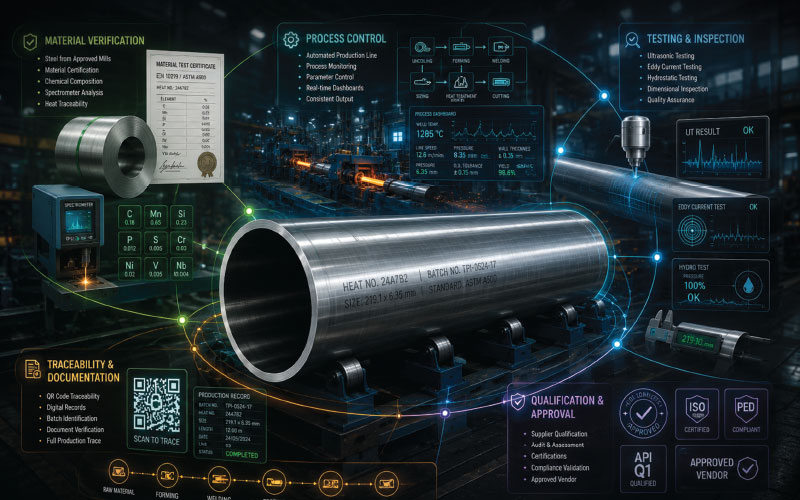
The answer extends beyond the finished product. While product specifications and compliance with applicable standards remain fundamental, customers increasingly seek evidence that these outcomes can be achieved consistently. Attention therefore extends to the systems that govern manufacturing itself, including raw material controls, production procedures, verification methods, and documentation frameworks.
This emphasis is particularly relevant because the tube and pipe industry serves a wide range of operating environments, from water infrastructure and industrial processing to automotive and oil & gas applications. The demands placed upon these products vary considerably, and so do the expectations placed upon the manufacturers supplying them.
Consequently, discussions around manufacturing capability increasingly focus on questions such as: How are materials verified? How are manufacturing variables controlled? How is consistency measured? And how is performance demonstrated to customers?
The recent interviews conducted by Tube & Pipe India suggest that answers to these questions are becoming an increasingly important part of supplier evaluation. Product quality remains essential, but manufacturing credibility is increasingly demonstrated through the capabilities that support consistent performance.
Quality as a Manufacturing Discipline
One of the strongest themes emerging from the conversations is the extent to which quality is discussed as a manufacturing discipline rather than an inspection activity.
When manufacturers describe their approach to quality, they rarely begin with final inspection or product testing. Instead, they refer to supplier selection, raw material verification, process planning, and customer-specific requirements. The emphasis is not solely on identifying defects but on reducing the likelihood of defects occurring in the first place.
This perspective is evident in the manner in which several companies describe their manufacturing systems. Akash Steel Crafts notes that every order is executed against a defined Quality Assurance Program (QAP), with production undertaken according to approved specifications and ASTM standards. Beyond documentation, such frameworks create consistency by aligning procurement, production, inspection, and reporting against predefined requirements.
A similar approach is reflected in comments from Goodluck India. Discussing the company’s quality philosophy, Chairman Mahesh Chandra Garg observes that quality “cannot be treated as a checkpoint—it must be embedded throughout the manufacturing process.” The statement captures a recurring theme across the interactions. Quality is frequently described not as a stage within manufacturing but as a characteristic of the manufacturing system itself.
When quality is embedded within manufacturing systems, attention shifts from correcting deviations to controlling the variables that create them. Supplier qualification, incoming material inspections, machine calibration, and process monitoring therefore become part of the quality framework.
Several manufacturers describe their operations in these terms. Hariom Pipes, for example, highlights the role of continuous monitoring and structured operating practices in maintaining product quality. The company’s emphasis on “consistency rather than correction” reflects a broader principle visible throughout the interviews: stable outcomes depend upon stable processes.
Similar emphasis on system-driven quality appears elsewhere in the industry. Avon Steel Industries highlights real-time process monitoring and integrated quality controls as part of its manufacturing framework, while Satyam Pipes points to standardised production practices and precision-focused operations as key contributors to product consistency.
Mahalakshmi Profiles and RR ISPAT similarly point to the advantages of integrated operations in maintaining consistency. Both companies emphasise that greater control over raw materials and production processes helps improve reliability, reduce disruptions, and support more predictable manufacturing outcomes.
This principle becomes particularly relevant as manufacturers serve a wider range of customer requirements. Product specifications may vary by application, but customers share a common expectation: the ability to receive products that perform consistently from one production batch to the next. Meeting that expectation requires systems capable of delivering repeatable outcomes under varying production conditions.
Verification Beyond Compliance
Process discipline establishes the conditions under which consistency can be achieved. Verification systems provide the means through which that consistency is measured and demonstrated.
For many manufacturers, testing has traditionally been associated with quality assurance at the end of the production cycle. The recent trend, however, suggests a broader role for inspection and testing infrastructure. Increasingly, these systems are being used not only to verify product conformity but also to generate information about manufacturing performance itself.
A test certificate may confirm that a product meets specification, but the data generated through testing can also reveal process deviations and opportunities for corrective action. In this sense, testing infrastructure functions not only as a verification mechanism but also as a source of manufacturing intelligence.
References to advanced inspection systems appear across the conversations. Manufacturers discuss hydrostatic testing, ultrasonic testing, eddy current inspection, and non-destructive testing as integral parts of their operations. While the specific technologies vary, the objective remains consistent: establishing confidence in product performance through measurable evidence.
Indipower Steel Works maintains critical welding parameters within documented control windows, with deviations triggering “investigation rather than simply correction.” Combined with inline eddy current testing and continuous dimensional gauging, this approach allows problems to be identified and addressed during production rather than at final inspection.
A similar emphasis on inspection capability is visible at Jindal Industries (Hissar), which refers to hydrostatic, ultrasonic, and eddy current testing for products serving demanding applications. MKK Metal Sections likewise points to investments in spectrometers and hydro-testing facilities to verify material composition, assess structural integrity, and document compliance against customer requirements.
The growing importance of inspection capability is also reflected in the observations of ISEND, a developer of non-destructive testing systems for tube and pipe manufacturers, which notes that manufacturers increasingly seek the ability to detect smaller and more complex defects while maintaining production efficiency. This reflects a broader expectation that inspection systems should provide greater confidence in manufacturing reliability rather than simply identify defects.
Techno India Manufacturing & Engineering Solutions (TIMES), an engineering and project solutions provider serving infrastructure and utility sectors, similarly points to the growing role of testing and inspection requirements in project-driven applications, where compliance must often be demonstrated through documented verification.
Testing systems are also becoming more closely integrated with production processes. The interviews indicate that inspection data is increasingly used to identify recurring process variations, refine operating parameters, and strengthen process stability over time. As a result, testing supports both verification and continuous improvement.
For customers operating in demanding environments, a test report often represents more than proof of conformity. It provides documented evidence that product performance has been assessed through recognised and repeatable methods.
Customers may never observe production processes directly, but inspection records and test certificates provide tangible evidence of how those processes are functioning. The ability to generate and substantiate such evidence is becoming an increasingly important aspect of manufacturing credibility.
When Performance Requirements Become More Demanding
The emphasis placed on process discipline and verification systems becomes easier to understand when viewed in relation to the environments in which tubes and pipes ultimately operate.
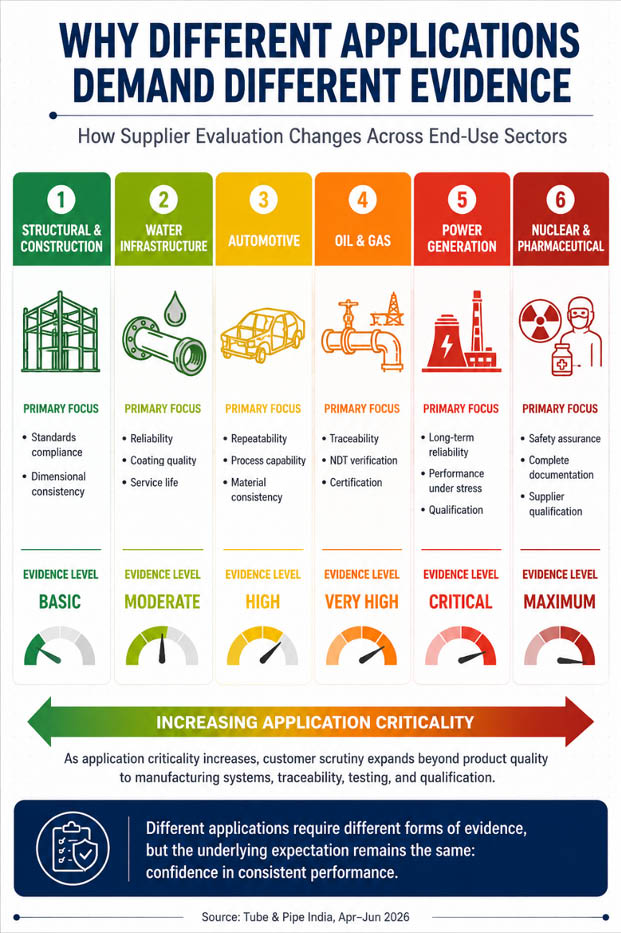
Although often discussed as a single manufacturing segment, the tube and pipe industry serves a wide range of operating conditions. Products intended for water infrastructure, pharmaceutical facilities, refineries, automotive systems, or nuclear installations may all fall within the same broad category, yet the demands placed upon them differ substantially.
The interactions repeatedly illustrate this diversity. Manufacturers cite demand from sectors such as automotive, pharmaceuticals, oil and gas, and power generation, while consistently linking manufacturing requirements to the conditions under which their products are expected to perform.
Lalbaba Engineering, for example, points to applications involving high pressure, elevated temperatures, and fatigue resistance. In such environments, performance expectations extend beyond compliance with dimensional specifications or mechanical properties. Long-term reliability under sustained operational stress becomes equally important.
A similar perspective emerges from Maharashtra Seamless, which highlights the requirements associated with oil and gas transportation, boilers, heat exchangers, and power generation systems. These applications often involve continuous exposure to pressure, temperature fluctuations, or corrosive media, making long-term performance a critical consideration.
The relationship between operating conditions and manufacturing requirements is perhaps most clearly articulated by REMI Group. Serving sectors such as nuclear energy, pharmaceuticals, and aerospace, the company notes that a substandard pipe in a nuclear plant or pharmaceutical facility is not merely a commercial issue but a safety concern.
Not all products are subjected to the same consequences of failure. As a result, customers seek varying levels of assurance regarding material quality, manufacturing controls, testing procedures, and traceability.
This is also reflected in the growing emphasis on specialised grades and application-specific solutions. Mukand Sumi points to increasing requirements in automotive and energy applications, where consistency in metallurgical properties directly influences performance. Similarly, Indipower Steel Works highlights the expectations of automotive and precision engineering customers, where manufacturing repeatability and process capability often receive the same level of scrutiny as the final product itself.
JTL Industries likewise highlights increasing demand for application-specific solutions across infrastructure and industrial segments, while Utkarsh India points to evolving requirements in solar structures and utility projects where operating conditions influence product specifications.
Similar trends are visible in stainless steel and specialty segments. Jindal Stainless points to growing demand from sectors requiring higher corrosion resistance and longer service life, while Kamdhenu Group highlights increasing attention towards specialised steel solutions aligned with specific end-use requirements.
These examples suggest that application requirements frequently shape manufacturing practices long before a product reaches the customer. Material selection, testing intensity, and documentation requirements are often determined by the intended operating environment rather than by the product category alone.
In this context, manufacturing credibility becomes closely linked to application understanding. Customers are not simply evaluating whether a manufacturer can produce a tube or pipe to specification. They are also evaluating whether the manufacturer understands the operating conditions under which that product will function and has applied appropriate controls throughout the manufacturing process. The more demanding the operating environment, the greater the importance attached to the evidence supporting product reliability.
Trust, Qualification and Market Access
The evidence generated through manufacturing systems, process controls, and testing infrastructure ultimately serves a practical purpose: it helps customers assess supplier capability before products enter service.
Manufacturers across different segments repeatedly refer to audits, certifications, approval systems, and customer-specific requirements when describing their business environment. These mechanisms provide a structured basis for evaluating manufacturing capability without relying solely on the finished product.
This becomes particularly relevant in sectors where the consequences of supplier failure extend beyond the replacement cost of a component. A tube or pipe may represent only a small portion of a larger system, yet failure can result in operational disruption, safety concerns, or project delays. As a result, customers often seek confidence in the manufacturing organisation as much as in the product itself.
This confidence is increasingly established through formal qualification frameworks. Certifications such as ISO standards, IATF requirements, ASTM compliance systems, and customer-specific approval procedures appear frequently across manufacturers serving different markets. While these frameworks differ in scope, they serve a common purpose: providing evidence that manufacturing activities are being performed within documented and verifiable systems.
Indipower Steel Works notes that automotive and precision engineering customers increasingly prefer to work with a smaller pool of suppliers that can demonstrate verifiable quality systems and documented manufacturing controls. The company’s emphasis on IATF-certified processes and traceable quality systems reflects a broader trend in which supplier evaluation extends beyond the product itself to the systems supporting its manufacture.
A similar pattern emerges across infrastructure and engineering applications. Manufacturers frequently refer to customer audits, approved vendor lists, quality documentation, and traceability systems as routine elements of commercial engagement. In many cases, qualification takes place long before an order is awarded, with customers first evaluating whether the supplier possesses the systems required to support the intended application.
Tata Steel also emphasises the importance of customer assurance mechanisms and project-specific compliance requirements, reflecting the growing role of qualification frameworks in supplier evaluation.
Akash Steel’s use of project-specific Quality Assurance Programs illustrates this relationship. Customer confidence is often supported through predefined inspection plans, documentation protocols, and agreed manufacturing controls rather than product inspection alone. Manufacturers serving regulated or technically demanding sectors describe qualification procedures that extend well beyond compliance testing. Viewed in this context, market access is increasingly linked to the ability to demonstrate capability through recognised and verifiable mechanisms.
The discussions also suggest that manufacturers are not evaluated through identical criteria. The depth of scrutiny often varies according to the application, operating environment, and risks associated with product performance. This variation helps explain why manufacturing credibility is established through different qualification and assurance requirements across different parts of the tube and pipe industry.
Also Read: Jindal Industries Hisar Pans Focus Across Scale, Specialisation and Expansion in the Steel Sector
A More Differentiated Manufacturing Landscape
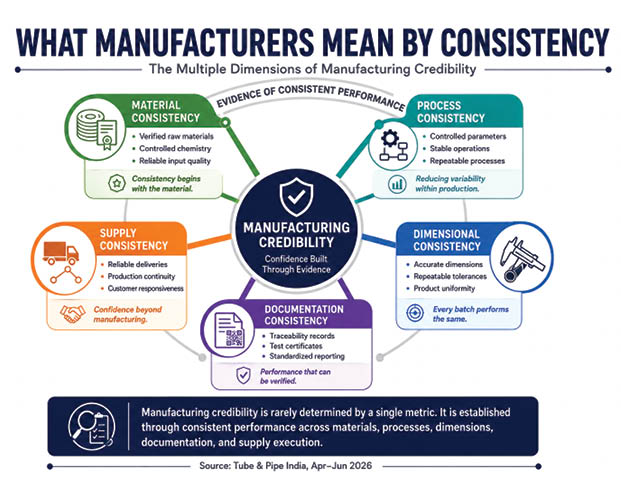
Taken individually, the themes discussed throughout the interactions may appear as separate operational priorities. Manufacturers speak about process controls, testing systems, traceability mechanisms, certifications, and application-specific requirements from different perspectives. Viewed collectively, however, they reveal a broader characteristic of the contemporary Indian tube and pipe industry: manufacturing capability is increasingly assessed through multiple layers of evidence rather than through product specifications alone.
This does not imply a single model of manufacturing across the industry. The sector continues to serve a wide range of products and applications, each with its own technical and commercial requirements. What the observations indicate instead is that supplier evaluation is becoming increasingly dependent on the demands of the application being served.
A manufacturer supplying products for general structural applications may face a different set of customer expectations than one serving automotive, pharmaceutical, or oil and gas applications. The differences often extend beyond product specifications to areas such as testing intensity, traceability requirements, qualification procedures, and the level of visibility customers seek into manufacturing processes.
As a result, manufacturers are required to demonstrate different forms of capability depending on the markets they serve. For some customers, compliance with applicable standards may be sufficient. For others, supplier evaluation may involve a detailed review of manufacturing systems, process controls, testing infrastructure, and quality documentation.
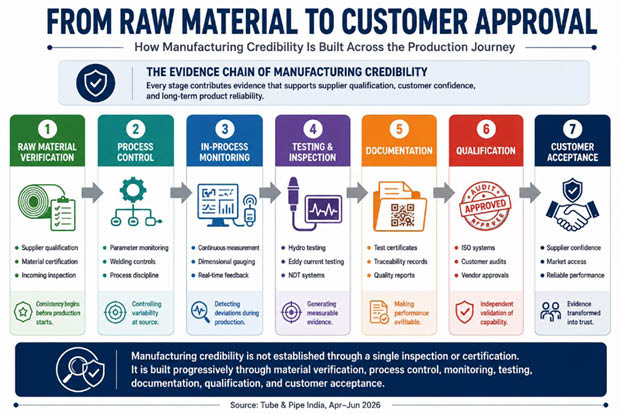
In a manufacturing environment, therefore, credibility is established through multiple forms of evidence. The nature of that evidence may vary from one application to another, but the underlying expectation remains consistent: customers increasingly seek confidence that performance can be delivered repeatedly under the conditions for which the product is intended.