
For tube and pipe manufacturers, an EPC order is the outcome of a procurement process that begins well before the RFQ, with qualification, capacity, quality, delivery and project requirements shaping who is ultimately able to compete.
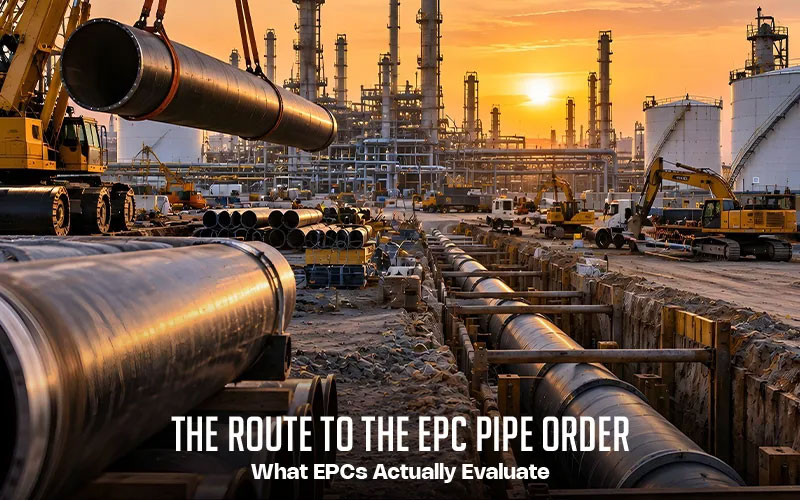
For a tube and pipe manufacturer, getting into an EPC project is not simply a matter of quoting for a pipe package when a tender appears. By the time a procurement enquiry reaches the market, much of the supplier’s credibility may already have been tested through technical capability, manufacturing capacity, quality systems, approvals, delivery record and the ability to support the project’s schedule.
The route from potential supplier to project supplier is shaped by a procurement system in which technical requirements, qualification, capacity, delivery, commercial considerations and project risk intersect. The process also extends across different project types, product categories, clients and sourcing geographies, making the question of how an EPC selects and secures pipe supply considerably broader than the RFQ itself.
For manufacturers, understanding that system means looking beyond the purchase enquiry to the decisions that determine which suppliers are qualified, which capabilities are considered suitable, how capacity and delivery are secured, and what ultimately makes one supplier more competitive than another.
The Scale of the Buying System
The scale behind this procurement system is considerable. L&T’s Energy Projects segment recorded INR 1,36,921 crore of order inflows in FY2025-26, up 56.4% year on year, with international orders accounting for 60%. Segment revenue reached INR 54,889 crore, of which 74% came from international markets. This provides an indication of the scale and geographical spread of the project pipeline feeding into the procurement system of a major EPC.
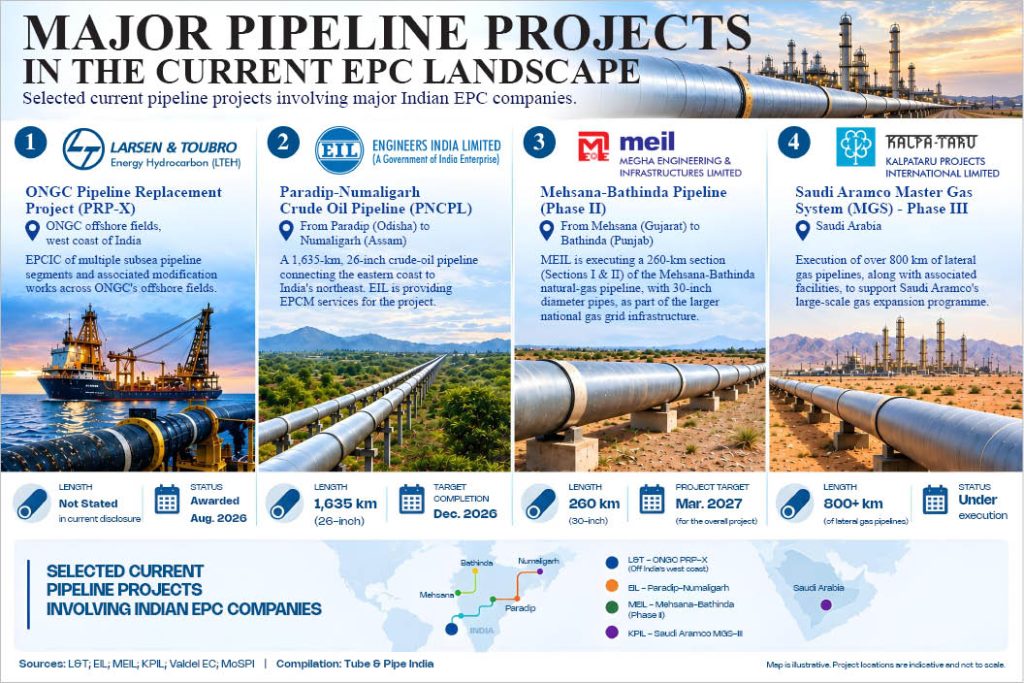
The picture is not limited to L&T. Engineers India Limited (EIL) ended FY2025-26 with an order book of INR 15,109 crore, up 28.9% year on year. Kalpataru Projects International Limited (KPIL), meanwhile, closed FY2025-26 with a consolidated order book of INR 65,457 crore, an all-time high, after securing INR 26,400 crore of new orders during the year. Its Oil & Gas business, particularly relevant to pipe-intensive EPC activity, accounted for INR 4,578 crore of the year-end order book, or 7% of the consolidated total.
Afcons Infrastructure Limited, another major Indian EPC player, closed FY2025-26 with an order book of INR 32,496 crore, of which Oil & Gas accounted for INR 528 crore, or 1.7%. The company’s wider portfolio also spans Marine & Industrial, which accounted for INR 4,779 crore (14.7%) of the order book, and Hydro & Underground, at INR 7,423 crore (22.8%), including LNG facilities and large water-supply pipeline projects that provide additional sources of demand for pipe, tube and associated steel products beyond its hydrocarbon business.
Together, these figures indicate the breadth of the project environment within which EPC procurement takes place, spanning different sectors, project types and geographies.
India’s underlying infrastructure base adds another dimension to this procurement universe. As of September 2025, the country had 34,238 km of authorised natural-gas pipelines, of which 25,923 km were operational and 9,954 km were under construction. According to PPAC data, India’s installed refinery capacity stood at 267.116 million tonnes per annum as of 1 April 2026. These figures do not translate directly into pipe demand, but they indicate the scale of the energy infrastructure base within which pipe-intensive EPC activity takes place.
For pipe manufacturers, the significance is straightforward: competition for an EPC order takes place within a procurement system where technical suitability, qualification, capacity, timing, risk and commercial competitiveness intersect. The scale of that system also means that manufacturers are not competing for isolated pipe orders, but for positions within a project ecosystem serving multiple projects, applications, materials, clients and geographies.
The scale, however, is only one part of the procurement equation. The requirements themselves span a wide range of products and materials.
What EPCs Actually Buy
The pipe requirement of a large EPC is far from a single commodity category.
L&T Energy Hydrocarbon’s requirements span carbon steel, low-temperature carbon steel, alloy steel, stainless steel, duplex and super-duplex stainless steel, nickel alloys, clad pipes and other piping components, with coated and uncoated requirements depending on the application. Mr. Paritosh Naik, Vice President & Head – Supply Chain Management, L&T Energy Hydrocarbon Onshore, also points to demand for higher-alloy materials, corrosion-resistant alloys, heavy-thickness pipes and non-metallic products such as GRE, GRV and GRUP.
The implication for manufacturers is that the addressable EPC market is segmented not merely by diameter or manufacturing route, but by service conditions, material requirements and project-specific specifications.
Current procurement activity elsewhere in the EPC ecosystem provides a useful snapshot. Engineers India Ltd’s live tender portal currently lists separate enquiries for SS seamless/welded pipes, CS/LTCS seamless/welded pipes and SS welded pipes for BPCL and Petronet projects.
This is important because it shows that the material mix described by L&T is not simply a corporate procurement philosophy. Different grades and product forms are being bought through multiple live project packages.
The point is not that these categories represent the entire EPC pipe basket, but that the live procurement record demonstrates the breadth of material and product specifications entering the market simultaneously.
When the Buying Process Begins
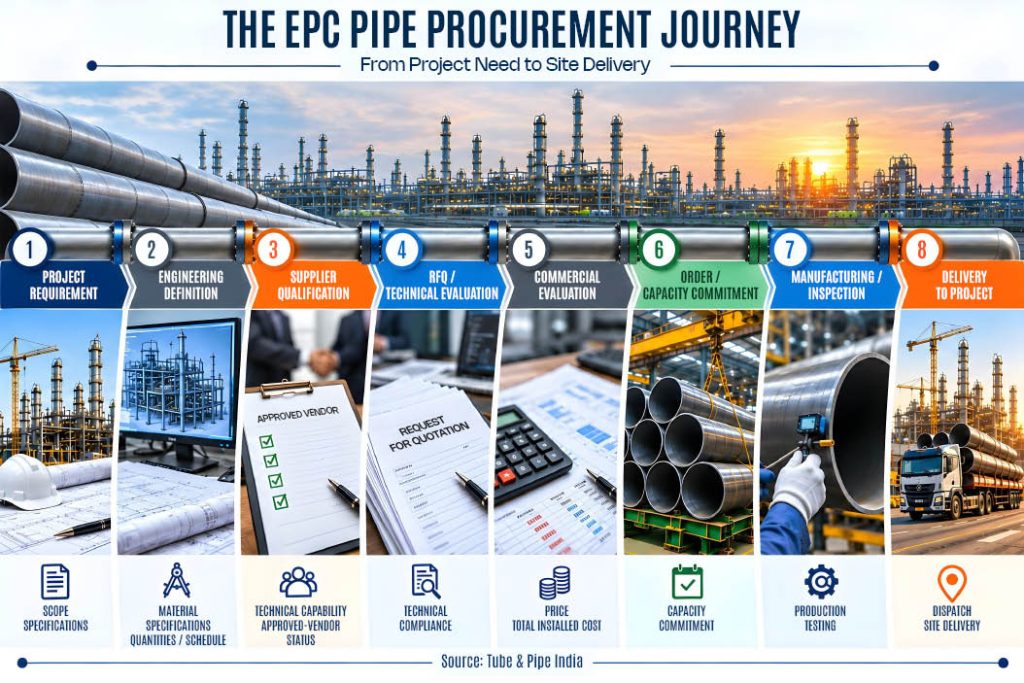
L&T Energy Hydrocarbon (LTEH), which executes projects across refineries, petrochemical complexes, gas processing and fertiliser facilities, engages engineering teams and potential suppliers as early as the bidding stage for major piping requirements. According to Mr. Paritosh Naik, Vice President & Head – Supply Chain Management, L&T Energy Hydrocarbon Onshore, major pipe requirements generally become sufficiently defined after basic engineering and a 40% isometric review during detailed engineering. Procurement engagement then proceeds once material specifications, quantities and project schedules are established.
For a manufacturer, however, the visible buying event may be the RFQ, while the EPC’s procurement planning has already begun. This early visibility matters because design development can affect quantities, material grades, wall thicknesses, manufacturing routes and delivery schedules. Coordination between engineering, procurement and project teams is therefore important to maintaining supplier commitments.
The implication for manufacturers is that procurement visibility does not necessarily begin with the final purchase enquiry. The earlier a supplier becomes relevant to the project, the greater the opportunity for its manufacturing capability and available capacity to be factored into the execution plan.
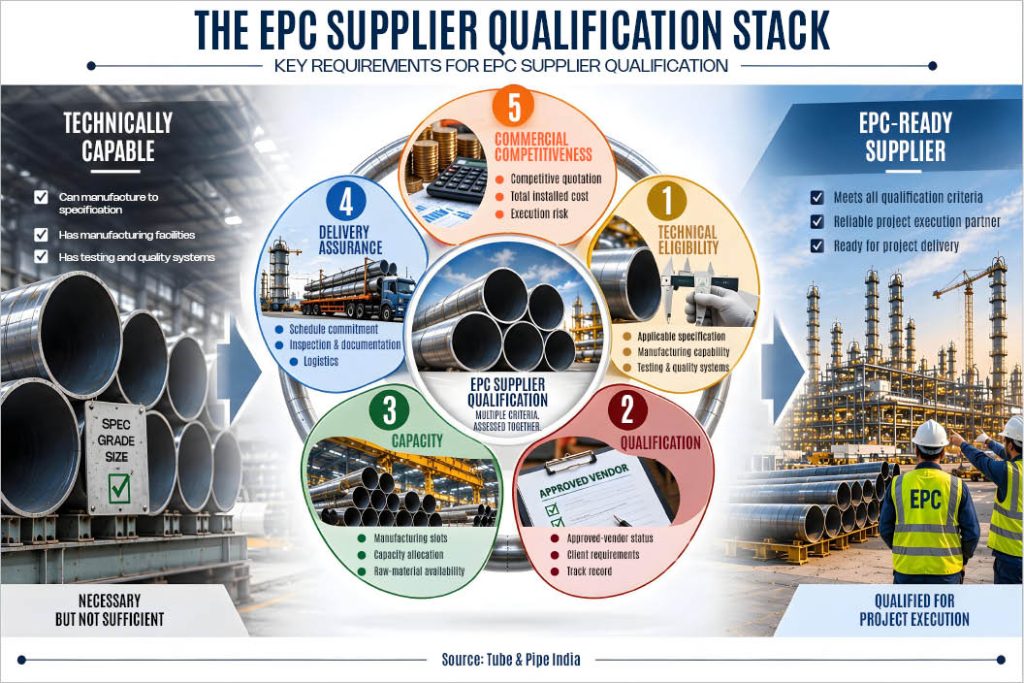
Getting Onto the List: Why Technical Capability Alone Isn’t Enough
This is perhaps the most important distinction emerging from the L&T response: Being technically capable is not the same as being an EPC-ready supplier.
L&T’s qualification process covers manufacturing capability and infrastructure, production capacity, quality-management systems, testing and inspection facilities, financial strength, HSE performance, past project execution for oil & gas, fertiliser and green-ammonia clients, compliance with applicable standards and end-customer approval. “For critical projects, successful execution history and demonstrated reliability are often as important as manufacturing capability,” says Paritosh Naik.
That makes supplier qualification a much broader test than whether a mill can manufacture a particular grade. The manufacturer’s capacity, quality system, testing infrastructure, financial standing, HSE record and project history all become part of its commercial proposition.
EIL’s procurement ecosystem provides an independent illustration of how such requirements sit within actual project procurement. Its current tender portal is actively handling multiple pipe packages for refinery and petrochemical clients, rather than treating piping as a single undifferentiated purchase category.
For manufacturers seeking EPC business, the implication is consequential: the first project can effectively become part of the qualification record. Winning it requires the supplier to demonstrate that it can fit into the EPC’s broader project-execution system.
Winning the Order: Why Price Alone Is Insufficient
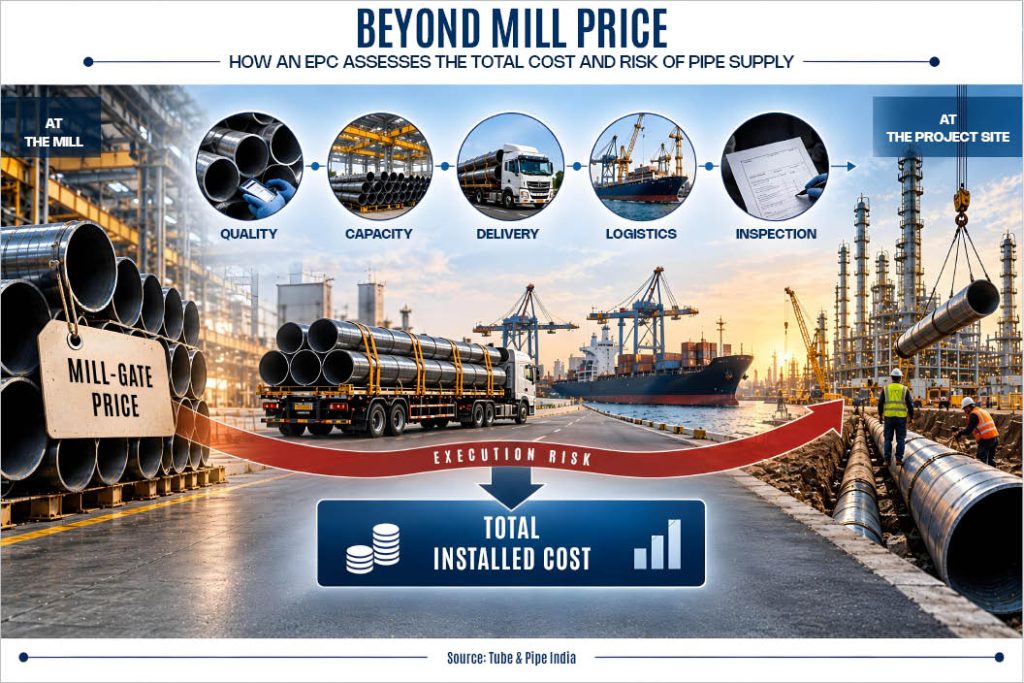
Once a manufacturer is technically qualified, another question begins: Why should this supplier get the order? L&T’s answer is unusually clear. The company follows a total-installed-cost approach. “We follow the concept of total installed cost,” says Naik. After technical qualification, sourcing decisions consider quality performance, manufacturing capacity, delivery capability, supply-chain reliability, commercial competitiveness, contractual terms and after-sales support. Cost remains important, but schedule assurance and execution reliability can be decisive on major EPC projects.
In practical terms, the manufacturer’s proposition is therefore not simply its mill price. The EPC’s assessment also takes into account quality, manufacturing capacity, delivery capability, logistics, reliability and the execution risk associated with the supplier. Taken together, these factors determine the total installed cost of the project.
That distinction is commercially significant. A supplier offering a lower ex-mill price but carrying greater delivery or execution risk may not represent the lowest-cost solution for the project as a whole.
For international projects, L&T also considers geopolitical conditions when sourcing to ensure timely delivery.
This explains why the procurement decision can favour a supplier that offers greater certainty even when its nominal quotation is not the lowest.
The Long-lead Challenge
Pipe procurement can also become a capacity-planning exercise. L&T says engagement with potential vendors begins during the pre-bid stage for large or schedule-critical projects. After award, technical and commercial closure begins using pre-bid inputs, while high-level steering committees are used to reduce the requisition-to-purchase-order cycle. For securing manufacturing capacity and production slots, higher-management engagement may be initiated, particularly where established supplier relationships exist. “In certain cases, manufacturing slots may need to be secured many months before field execution activities commence to ensure project schedule protection,” says Naik.
This changes the manufacturer’s commercial calculation. A mill does not necessarily wait until the physical requirement is imminent before considering capacity. For a schedule-critical package, capacity itself can become a procurement input.
The wider EPC environment illustrates why this matters. EIL’s current procurement portal simultaneously carries pipe enquiries for different refinery and petrochemical projects, including CS/LTCS seamless/welded and SS seamless/welded pipes.
For a manufacturer serving several EPCs, the commercial challenge is therefore not simply possessing annual installed capacity. It is being able to demonstrate available, allocable and schedule-compatible capacity when the EPC needs it.
India or Elsewhere?
L&T’s sourcing model is neither purely domestic nor purely global. The company says a sizeable portion of its requirements is fulfilled by qualified Indian manufacturers, while international suppliers remain relevant for specialised products, larger production capacities, advanced manufacturing technologies and competitive commercial opportunities.
“L&T Energy Hydrocarbon adopts a balanced sourcing strategy leveraging both domestic and international manufacturing capabilities,” says Paritosh Naik. He adds, “India has developed a strong and globally competitive pipe manufacturing ecosystem, and a sizeable portion of our requirements are fulfilled through qualified domestic manufacturers.”
The sourcing decision considers technical requirements, approved-vendor status, project schedule, delivery commitments, quality performance, total installed cost, localisation requirements and supply-chain resilience.
The scale of L&T’s international work reinforces the importance of this balance. In FY2025-26, international revenue accounted for 74% of Energy Projects’ INR 54,889-crore revenue, while international orders represented 60% of the segment’s INR 1,36,921-crore order inflow.
The question for an Indian pipe manufacturer is therefore not simply whether it can compete with an overseas mill on price. It is whether it can offer the technical range, production scale, qualification status, delivery reliability and documentation needed for the particular project.
For specialised products, the international supply base remains relevant. For standard and qualified requirements, India’s pipe-manufacturing ecosystem provides a substantial sourcing base.
Price and Supply Risk
The procurement decision also has to account for what happens between quotation and delivery.
L&T manages material-price and supply risks through advance procurement planning, market intelligence, regular supplier engagement, aggregation of ordering quantities across projects and business units, competitive bidding, long-term price agreements, long-term supplier relationships and contractual risk-sharing mechanisms.
There is a measurable market backdrop to this. Government data put the average Indian price of 2-mm HR coil at INR 70,448 per tonne in August 2026, 15.5% above August 2025. Finished-steel consumption during April-August 2026 was 70.3 million tonnes, up 7% year on year.
HR coil is not a universal proxy for the raw-material cost of every pipe category, but the figure illustrates the kind of underlying price movement against which long-duration procurement decisions have to be made.
Importantly, L&T does not describe price management as a single hedging exercise. It combines planning, market intelligence, purchasing scale, supplier relationships and contractual mechanisms.
KPIL’s disclosures provide useful independent corroboration. The company identifies pipe and pipe fittings among the commodities used in project execution and says price exposure is managed through escalation clauses where available; for firm-price contracts, it uses forward contracts or back-to-back firm-price arrangements where possible, with contingencies for risks that cannot be hedged.
That is a significant point for manufacturers: EPCs themselves have to manage commodity risk, and the contractual structure through which they buy can become part of that risk-management system.
The Less Visible Constraints
Some of the factors that can complicate pipe procurement are less visible than price or technical specification.
L&T identifies several less visible constraints that can complicate an otherwise straightforward procurement. These include client-approved vendor restrictions, limitations on the raw-material sub-vendors that mills can use, minimum-order quantities for certain requirements, the capability and available capacity of individual mills, and the fact that a single source may not be able to meet the full range of pipe requirements in a package. Differences in documentation, specifications and ordering requirements across clients and vendors can add another layer of complexity.
These constraints help explain why a pipe requirement can become difficult to consolidate into a single order.
A mill may be qualified for the pipe itself but constrained by the client’s approved raw-material source. It may have sufficient annual capacity but not the appropriate production slot. It may be commercially competitive for the main quantity but inefficient for a small top-up requirement because of MOQ.
This is where the distinction between manufacturing capability and procurement usability becomes important.
The EPC does not simply need a mill that can make the pipe. It needs a supplier that can fit the pipe into a project-specific procurement and execution system.
Also Read: Tube & Pipe India Emagazine Jul-Sep Issue 2026
What the Evidence Means for Pipe Manufacturers
For a pipe manufacturer, the EPC procurement process therefore has to be viewed as more than an opportunity to quote against an RFQ. Technical capability and compliance with the required specification are the starting point, but they do not by themselves establish a supplier’s suitability for a project. Qualification, manufacturing capacity, quality and testing systems, execution record, delivery capability and the ability to meet project-specific requirements all contribute to the EPC’s assessment of whether a supplier can be relied upon for the job.
Aaditya Stainless’ experience illustrates how such qualification can translate into access to project procurement. Shreyansh Bhansali, Director, Aaditya Stainless Pvt. Ltd., says, “Over the last few years, we have secured several key industry approvals, including EIL, IOCL, and ADNOC among others. These approvals have enabled us to directly participate in and supply products for major oil & gas projects.”
L&T’s approach to sourcing reinforces this broader assessment. Technical requirements and approved-vendor status are considered alongside schedule, delivery commitments, quality performance, total installed cost, localisation requirements and supply-chain resilience. For the manufacturer, installed capacity on paper is not enough; what matters is the ability to commit the right capacity at the right time, meet the required quality and documentation standards, and provide confidence that the material will reach the project when it is needed.
This also puts the question of price in its proper context. A competitive quotation remains essential, but the EPC’s assessment extends beyond the mill-gate price to the wider cost and execution implications of the supply. A supplier that combines competitive pricing with proven quality, available capacity, reliable delivery and lower execution risk can therefore offer greater value than one whose principal advantage is a lower initial quotation.
For manufacturers, the implication is that EPC competitiveness is built across several dimensions: technical capability and qualification establish eligibility; available capacity and delivery assurance support project execution; and commercial competitiveness determines whether the supplier can offer an acceptable overall proposition.
MAN Industries’ position in the large-diameter line-pipe market provides a relevant manufacturer perspective on these requirements. The company has a manufacturing presence in Saudi Arabia and has pursued access to major energy-project procurement programmes in the region, including through its relationship with Saudi Aramco. It is also an approved vendor for QatarEnergy LNG, positioning it to participate in LNG infrastructure projects.
The broader definition of competitiveness is also reflected in industry experience. Nikhil Mehta of MAN Industries says, “Competitiveness in the large-diameter pipe industry is increasingly determined not just by capacity, but by quality consistency, technology differentiation, and supply-chain reliability.”
L&T’s Energy Projects segment alone generated INR 1,36,921 crore of orders in FY2025-26, while EIL ended the year with an order book of INR 15,109 crore, up 28.9% year on year. EIL’s current procurement activity includes multiple live pipe packages across SS, CS and LTCS categories. The project portfolio of Megha Engineering & Infrastructures Ltd (MEIL) illustrates the physical scale at which pipe-intensive infrastructure can be executed: its Rajasthan refinery work includes a 210-km, 52-inch carbon-steel raw-water pipeline and a 489-km crude-oil pipeline.
But scale alone does not determine who gets the order. These factors have to work together. A technically capable mill may not protect the schedule if the required capacity is unavailable; capacity alone does not help if the supplier is not qualified; and a competitive price may not produce the lowest project cost if delivery carries significant risk.
The purchase order may be issued for pipe. The decision, however, is made on confidence in the supplier’s ability to deliver the project.
Editorial note: This story focuses primarily on EPC procurement practices in oil & gas and related energy-infrastructure projects; references to EPC procurement are made within this context.