
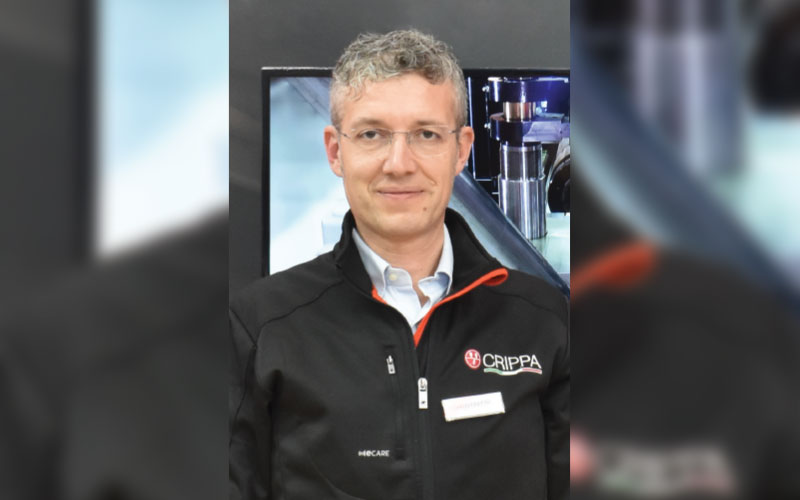
Crippa Srl, part of the OCTA Group, sees India as a rapidly evolving manufacturing hub with a growing demand for high-end technology. The company recently increased its investments in the region to ensure it is physically closer to the customers. In an exclusive interview with Tube & Pipe India, Mr. Carlo Fratini, Business Development Manager, Crippa Srl, discusses the company’s technology focus, automation strategies, and plans to expand its footprint in the Indian market.
Tube & Pipe India: Please briefly indicate the processing technologies or equipment segments your company specialises in.
Carlo Fratini: Since 1948, Crippa Srl has been a global leader in the design and manufacture of high-precision CNC tube bending and tube end-forming machines. As part of the OCTA Group, we provide fully integrated automated cells, specialized loading/unloading systems, and advanced software solutions tailored for the demanding requirements of the automotive, aerospace, and HVAC industries.
TPI: Within your area of processing expertise, which performance parameters are under the greatest pressure to improve productivity or cost efficiency?
CF: The primary pressure lies in reducing cycle times while maintaining absolute precision. In high-volume sectors like automotive and HVAC, our customers demand high-speed axis movements and rapid tool changeovers. We focus on maximizing “uptime” through full electric technology, which eliminates the variables of hydraulic systems, ensuring lower energy consumption and higher repeatable speed.
TPI: Where are customers seeing the largest quality or yield gains from upgrades in tube processing equipment?
CF: The most significant gains are found in scrap reduction and operational flexibility. Even when dealing with small production batches, our customers benefit from exceptionally fast and easy retooling, which is critical for maintaining high productivity in high-mix environments. Furthermore, by utilizing our advanced sensors and “Springback” compensation software, our machines adjust in real-time to material variations, ensuring the highest quality from the very first part.
TPI: How are brownfield constraints influencing equipment design, line integration, and automation levels?
CF: Many of our customers operate in established facilities with limited floor space. To address this, we design compact, modular cells and utilize multi-stack bending heads that allow complex geometries to be produced in a single footprint. Our integration expertise allows us to “drop in” automated solutions that communicate seamlessly with existing legacy MES (Manufacturing Execution Systems).
TPI: What role does real-time monitoring or closed-loop control play in maintaining process stability, consistency, or repeatability within your processing technology?
CF: It is fundamental. Crippa’s systems employ closed-loop control to monitor torque, position, and material resistance constantly. This ensures that the first part produced is identical to the thousandth, regardless of slight variations in the tube’s batch quality or environmental temperature changes.
TPI: Which material grades, product specifications, or end-use requirements are currently demanding tighter process control within your area of expertise?
CF: We are seeing a shift toward high-strength stainless steels, titanium, and exotic alloys in aerospace, as well as thin-walled aluminum for EV thermal management in the automotive sector. These materials have narrow windows for successful deformation, necessitating the extreme precision and tactile feedback found in our latest CNC generations.
TPI: How are energy efficiency and thermal optimisation being addressed in processing operations, particularly heat treatment?
CF: As a company committed to sustainability, we have transitioned heavily toward full-electric platforms. These machines consume power only when moving, unlike hydraulic systems that require constant cooling and energy. For integrated processes involving thermal treatments, we focus on optimizing induction heating cycles to ensure energy is applied only where and when necessary.
TPI: How important is integration with upstream tube mills and downstream inspection systems in achieving stable operations?
CF: Integration is the key to a “zero-defect” strategy. Our machines are designed to interface directly with downstream 3D measuring cells. If a deviation is detected, the inspection system sends a corrective signal back to the Crippa bender, which automatically adjusts the next bend. This creates a self-correcting ecosystem that ensures total process stability.
Also Read: OLIMPIA 80 Srl: Focuses on Customised Tube Mill Solutions for Evolving Industry Demands
TPI: Looking ahead, within your area of processing expertise, which aspects of your technology are most likely to see increased investment focus?
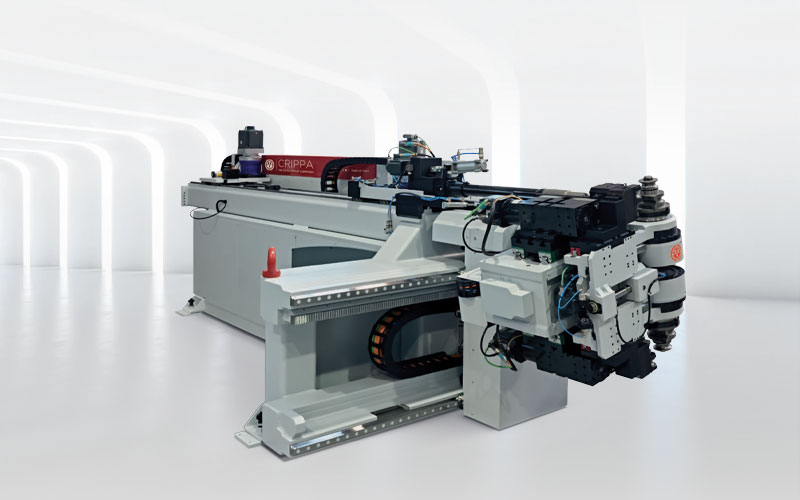
CF: Our R&D is heavily focused on artificial intelligence and predictive maintenance. We are investing in software that can predict tool wear and optimize bending sequences automatically. Our innovative tube bending machine R42, through high personalization and flexibility and absolute control of each movement, assures high quality and precision bends, very short set-up and scrap times. Our new Siemens SINUMERIK ONE control model defines new standards in processing speed, allowing PLC cycle times up to 10 times faster than its predecessor.
Furthermore, we are continuously expanding our global footprint to ensure that our advanced technology is backed by local, high-level technical support.
TPI: How do you see India as a market?
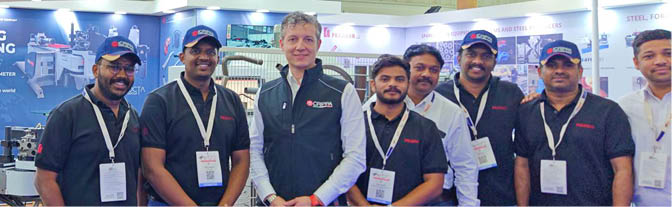
CF: India is a cornerstone of Crippa’s global strategy. We see it as a rapidly evolving manufacturing hub with a growing demand for high-end technology. To support this, we are deeply rooted in India with an extensive sales and service network. We have recently increased our investments in the region to ensure we are physically closer to our customers, providing them with immediate technical assistance, spare parts, and the expertise required to compete on a global scale.
Our participation in the IMTEX, METEC and Tube & Wire Fair represents an important step forward in our international expansion strategy and offers us the opportunity to present innovative solutions to an audience of experts and potential clients.

India is a cornerstone of Crippa’s global strategy. We see it as a rapidly evolving manufacturing hub with a growing demand for high-end technology. To support this, we are deeply rooted in India with an extensive sales and service network. We have recently increased our investments in the region to ensure we are physically closer to our customers, providing them with immediate technical assistance, spare parts, and the expertise required to compete on a global scale.