
As industries such as automotive, oil & gas, power generation, and heavy engineering continue to demand higher-performance materials, the role of advanced alloy steels has become increasingly critical. With a growing focus on quality, consistency, safety, and import substitution, Indian manufacturers are steadily strengthening their position in the global specialty steel landscape. In an exclusive interview with Tube & Pipe India, Mr. Vipul Mashruwala, President, Mukand Sumi Special Steel Limited, discusses the company’s alloy steel capabilities, integrated manufacturing strengths, focus on metallurgical excellence, and its vision for supporting high-performance applications through innovation, customer collaboration, and world-class quality standards.

Tube & Pipe India: Mukand Sumi has developed a wide portfolio of alloy steel grades for demanding applications. How do your alloy steel capabilities translate into value for tube and pipe manufacturers, particularly in high-performance segments such as energy, automotive, and engineering?
Vipul Mashruwala: At Mukand Sumi, our approach to alloy steel goes beyond supplying a material – we focus on enabling performance, reliability, and manufacturing efficiency for our customers. Our wide portfolio of more than 400 alloy steel grades is designed to meet stringent application requirements, whether it is for engineering applications, automotive components, or high-pressure and high-temperature service conditions. We work closely with customers to provide steel with consistent chemistry, cleanliness, and metallurgical integrity, which are critical for ensuring predictable downstream processing and superior end-product performance.
For the automotive sector, the focus is increasingly on lightweighting, durability, and performance efficiency. Our alloy steel products support the manufacturing of critical applications where strength, fatigue resistance, and reliability are essential. In engineering and industrial applications, customers value consistency and enhanced machinability, which directly contribute to better productivity and reduced process variability.
Similarly, in energy-related applications – including oil & gas and infrastructure-linked segments – performance under demanding operating conditions is paramount. The ability to provide high-quality alloy steel with dependable mechanical characteristics help us in meeting increasingly stringent performance expectations.
What differentiates Mukand Sumi is not just our product range, but our ability to partner with customers in application development, quality assurance, and technical support. As the market increasingly moves toward higher-performance materials and import substitution, we see significant opportunities to deliver greater value through advanced alloy steel solutions backed by robust manufacturing capabilities and deep metallurgical expertise.
TPI: With numerous alloy steel grades and a strong focus on long products, how do you ensure consistency in metallurgical quality and process control, especially for critical applications?
VM: At Mukand Sumi, consistency in metallurgical quality is non-negotiable, particularly when serving critical applications where performance, safety, and reliability are paramount. Whether the end application is in automotive, engineering, energy, bearings, or other demanding sectors, our customers expect steel products that perform consistently every single time – and our manufacturing philosophy is built around delivering exactly that. Our products are crafted from carefully sourced from the blooms and billets, exclusively procured from Mukand Limited, ensuring unrivalled quality and reliability.
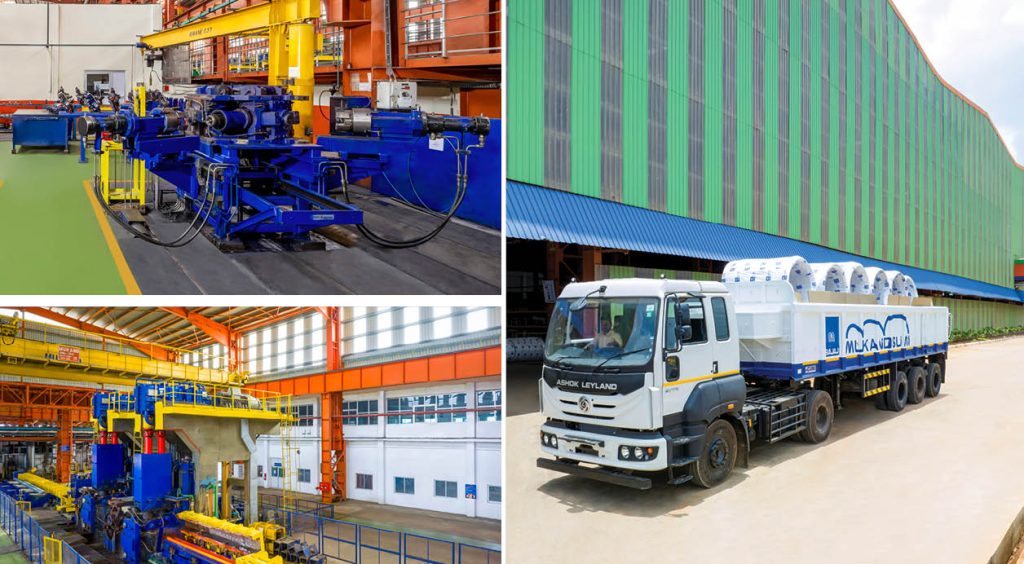
A key differentiator for Mukand Sumi is our strong focus on process capability supported by advanced testing and inspection infrastructure. For bright bars, we have Automatic Ultrasonic Testing (UT) equipment for diameters ranging from 9.5 mm to 35 mm, enabling us to ensure internal soundness and defect detection for critical applications. In addition, our Automatic Eddy Current Testing systems for bright bars (5 mm to 35 mm diameter) and wires (5 mm to 36 mm diameter) help ensure superior surface and near-surface defect detection, which is especially important for high-performance engineering and automotive applications.
Our SBQ bar and wire rod mill is equipped with advanced process controls designed to deliver superior product consistency and quality. This includes a walking beam furnace for uniform heating, online size measurement systems for dimensional accuracy, and surface quality inspection systems to maintain stringent quality standards. The mill is further supported by an Automatic Bar-Coil Handling System, which minimises manual intervention and enhances product integrity through efficient handling practices. Additionally, we have Automatic Phased Array Ultrasonic Bar Testing capability up to 130 mm diameter, strengthening our ability to meet stringent internal quality requirements for critical and safety-sensitive applications.
Our manufacturing infrastructure, backed by advanced metallurgical practices and stringent quality systems, enables us to consistently produce alloy steel products that meet highly demanding customer specifications. Equally important is our focus on process discipline, digital monitoring, and continuous improvement initiatives, which help minimise variability and enhance repeatability in production.
TPI: Advanced applications such as oil & gas, power generation, and heavy engineering demand superior mechanical and fatigue properties. How is Mukand Sumi aligning its alloy steel development to meet these evolving requirements?
VM: Advanced sectors such as oil & gas, power generation, and heavy engineering are evolving rapidly, with increasing emphasis on performance, reliability, and longer service life of components operating under highly demanding conditions. Materials used in these applications are expected to withstand high temperatures, pressure, cyclic loading, wear, and challenging operating environments, making superior mechanical properties, fatigue resistance, and metallurgical consistency absolutely critical. At Mukand Sumi, our alloy steel development strategy is closely aligned with these evolving industry requirements.
Our approach is centred on developing and supplying alloy steel grades with enhanced strength, toughness, cleanliness, hardenability, and fatigue performance for mission-critical applications. We are continuously strengthening our metallurgical capabilities to deliver steels that offer superior consistency and reliability, particularly for components used in energy, industrial engineering, seamless tubes, forgings, shafts, and pressure-related applications.
A key aspect of meeting these advanced performance requirements lies in ensuring high levels of steel cleanliness, internal soundness, and dimensional precision. This is where our manufacturing and testing capabilities play a vital role. We have invested significantly in advanced quality assurance infrastructure to support critical applications.
Our recently announced integrated steel plant is also an important strategic enabler in this journey. Beyond expanding capacity, it will enhance process integration, manufacturing efficiency, and technological capability, enabling us to cater more effectively to the growing demand for high-performance special steels across sectors such as oil & gas, power generation, heavy engineering, automotive, and industrial manufacturing.
TPI: Mukand Sumi has invested in integrated steelmaking facilities. How do these upstream capabilities enhance steel quality in terms of cleanliness, consistency, and overall performance across demanding applications?
VM: At Mukand Sumi, we firmly believe that superior steel quality is built through strong upstream integration and robust process control. In special and alloy steel, particularly for demanding applications, the final product quality is fundamentally determined by how effectively the steelmaking process is controlled right from the melting stage. This is where integrated steelmaking capabilities become a significant differentiator.
For sectors such as automotive, oil & gas, power generation, bearings, engineering, and heavy industrial equipment, customers increasingly demand steels with superior internal soundness, enhanced fatigue performance, and predictable machinability. Integrated steelmaking helps us minimise process variability and maintain stringent control over inclusion levels, microstructure, segregation, and mechanical properties – factors that directly influence component performance and service life.
One of the key benefits of upstream integration is improved steel cleanliness, which is essential for fatigue-sensitive and high-performance applications. By maintaining tighter control over melting and refining practices, we are able to produce steels with enhanced metallurgical integrity and consistency. This translates into improved performance during downstream processing and greater reliability in end-use applications.
Our recently announced integrated steel plant marks an important milestone in strengthening these capabilities further. Beyond increasing capacity, the investment is aimed at deeper process integration, enhanced operational efficiency, and greater flexibility in developing advanced alloy steel solutions for evolving market needs. As customer expectations continue to rise, particularly in high-performance sectors, such integrated capabilities will become increasingly important in delivering world-class quality, consistency, and application performance.
TPI: As global standards for engineered steel products become increasingly stringent, particularly in safety-critical sectors, how important is in-house R&D and customer-specific customization in shaping your product development strategy?
VM: We believe that in today’s evolving special steel landscape, in-house R&D and customer-specific product development are no longer optional – they are strategic imperatives. As global standards become increasingly stringent, particularly in safety-critical sectors such as automotive, energy, bearings, railways, engineering, and heavy industrial applications, the expectation is not only to meet specifications but to consistently deliver superior performance, reliability, and process consistency.
The nature of engineered steel products has changed significantly over the years. Customers today are seeking materials that can support lighter designs, higher strength-to-weight ratios, improved fatigue performance, better machinability, tighter dimensional tolerances, and longer service life. At the same time, global OEMs and Tier-1 suppliers are adopting increasingly rigorous qualification and validation standards. This makes metallurgical innovation and application-focused development absolutely critical.
At Mukand Sumi, our product development strategy is strongly driven by in-house metallurgical expertise, process optimisation, and close customer collaboration. Our R&D efforts are focused on enhancing steel cleanliness, hardenability, machinability, consistency, and overall application performance. More importantly, we work closely with customers to understand their end-use requirements, processing conditions, and performance expectations, enabling us to develop steel solutions tailored to specific applications rather than taking a one-size-fits-all approach.
Customer-specific customisation is particularly important in sectors where operating conditions are highly demanding and even minor material variations can significantly impact performance or safety. Whether it is alloy design, chemistry optimisation, mechanical property requirements, heat treatment response, or dimensional consistency, our objective is to align product characteristics with the customer’s manufacturing and application needs.
Also Read: ISEND Driving Smarter Quality Control Through AI-Powered NDT Solutions
TPI: With rising demand for high-quality alloy steels and a gradual reduction in import dependence, how do you see the role of Indian manufacturers like Mukand Sumi evolving within the global specialty steel value chain?
VM: The global specialty steel landscape is undergoing a significant transformation, driven by shifting supply chains, increasing focus on resilience, and the growing need for reliable, high-performance material solutions. At the same time, India is emerging as an increasingly important manufacturing hub, supported by strong domestic demand, infrastructure growth, automotive expansion, engineering capabilities, and policy emphasis on localisation and import substitution. This presents a significant opportunity for Indian manufacturers to play a much larger role in the global specialty steel value chain.
Historically, a considerable portion of high-grade special and alloy steels, particularly for demanding applications, was dependent on imports due to stringent quality requirements and application complexity. However, this trend is gradually changing. Indian steel manufacturers have made substantial investments in technology, process integration, quality systems, and metallurgical capabilities, enabling the domestic industry to increasingly meet global benchmarks in terms of quality, consistency, and performance.
The role of Indian manufacturers is now evolving from being predominantly cost-competitive suppliers to becoming technology-driven, value-added material partners capable of supporting advanced applications across automotive, engineering, energy, bearings, railways, and industrial sectors. Going forward, the ability to consistently produce cleaner steels, tighter metallurgical tolerances, superior fatigue properties, and application-specific grades will determine competitiveness in global markets.
Equally important is the growing expectation for customer collaboration. Global OEMs and engineering companies increasingly seek partners who can support product development, localisation, and performance optimisation. This is where integrated manufacturing capabilities, strong metallurgical expertise, and application engineering become key differentiators.
We believe India is moving toward becoming a globally competitive source for advanced alloy and specialty steels – not only catering to domestic demand but increasingly participating in global supply chains for high-performance applications. The opportunity ahead is substantial, but success will depend on continuous investment in technology, quality, R&D, and long-term customer partnerships.

In energy-related applications – including oil & gas and infrastructure-linked segments – performance under demanding operating conditions is paramount. The ability to provide high-quality alloy steel with dependable mechanical characteristics help us in meeting increasingly stringent performance expectations.