
As the global steel industry pivots from volume-driven production to value-led solutions, integration is no longer a strategic choice, it is also a competitive necessity. At the forefront of this transformation, Tata Steel is reshaping the tubes and pipes segment by seamlessly linking raw materials, steelmaking, and downstream applications into a unified, customer-centric ecosystem. In an exclusive interview with Tube & Pipe India, Mr. Vijaya Kumar Dara, Chief (Marketing & Sales) – Tubes, Tata Steel Limited, explains how this fully integrated model is enabling the company to move beyond manufacturing into turnkey execution, drive innovation across high-growth sectors, and build long-term competitiveness in an increasingly complex infrastructure landscape.
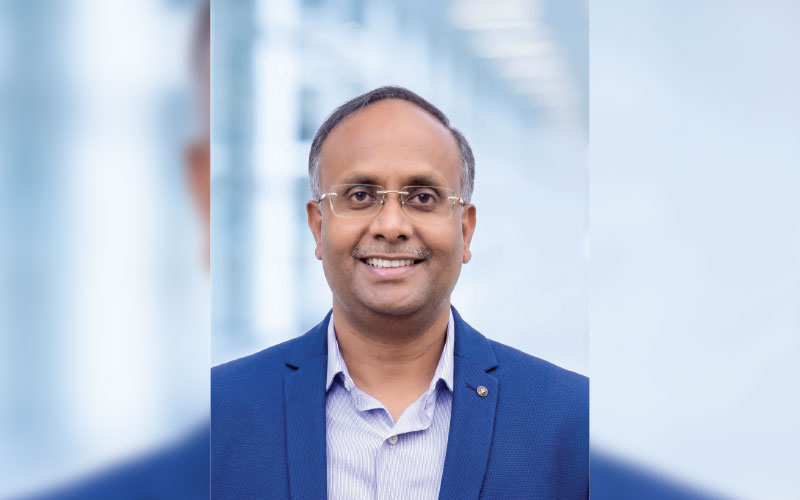
Tube & Pipe India: As companies increasingly advance downstream from steelmaking to finished pipe solutions, and vice-a-versa, how is integration reshaping your role as a manufacturer, product supplier, and then a solution or execution partner?
Vijaya Kumar Dara: Integration in business is reshaping our role across the value chain. As a manufacturer, integration lets us treat steelmaking and tube-making as a single engineered process, enabling us to tailor steel grade and finishing specifically for each pipe or tube application. This upstream–downstream control improves yield, reduces rework, and strengthens predictability of quality and delivery.
As a product supplier, integration moves us beyond standalone pipes and tubes to bundled, application-specific solutions. We can design systems such as coated or lined pipe packages (Tata Ductura) for water projects, or pre-cut structural-tube bundles (Tata Structura) for construction, where components are matched for compatibility and installation ease. This positions us as a value-added partner aligned with how Tata Steel’s Tube Division is evolving into a diversified solutions provider.
As a solution or execution partner, integration pulls us into the project lifecycle so we can align supply with construction schedules, provide design inputs on tube-based framing, and support documentation and compliance for large infrastructure, oil & gas, and industrial projects. This end-to-end approach positions us as a coordinated execution partner sharing project-level responsibility with Engineering, Procurement, and Construction (EPCs) and contractors, in line with Tata Steel’s broader integrated-chain strategy.
TPI: How does integration strengthen your competitiveness in the overall ecosystem of the steel sector?
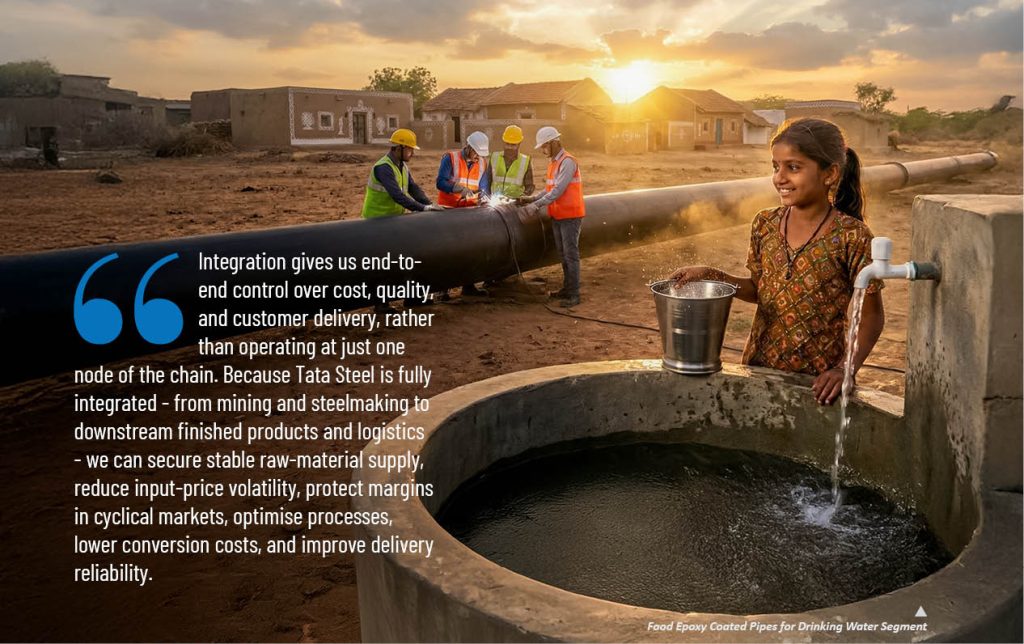
VKD: Integration gives us end-to-end control over cost, quality, and customer delivery, rather than operating at just one node of the chain. Because Tata Steel is fully integrated – from mining and steelmaking to downstream finished products and logistics – we can secure stable raw-material supply, reduce input-price volatility, protect margins in cyclical markets, optimise processes, lower conversion costs, and improve delivery reliability.
On the customer side, this integration lets us design tailored steel grades and finished products that match exact application needs, such as high-strength automotive steel, coated sheets, or structural tubes, instead of offering generic products. Downstream capabilities like Tata Steel Processing and Distribution Limited (TSPDL) enable just-in-time delivery, value-added processing, and closer alignment with builders and OEMs, enhancing our responsiveness and customer stickiness. Within the broader ecosystem, this integrated model positions Tata Steel as a scale-efficient, technology-driven steel partner, well placed to capture larger share in high-growth domestic segments while adapting to global decarbonisation trends.
TPI: In which segments (oil & gas, water, infrastructure, construction) is integrated capability becoming a key differentiator?
VKD: Integrated capability is becoming a key differentiator in oil & gas, water, infrastructure, and large-scale construction segments. Our integrated chain – from steelmaking to high-specification line-pipe and coating – supports demanding projects such as deep-water pipeline contracts, where traceability, quality, and safety-grade compliance are critical. In water and utilities, initiatives like the 5 million liters per day (MLD) water treatment plant and smart automated water-supply systems in Jamshedpur show how we combine steel-based infrastructure with end-to-end water-management solutions for large-scale civic supply. In infrastructure and construction, supplying Tata Ezyfit door/window frames & handrails as ready-made components drastically reduces material loss and simplifies the fabrication process through precision engineering and pre-configured designs.
TPI: To what extent does control over raw materials and steel quality influence the performance of your downstream pipe/tube products?
VKD: For an integrated steel manufacturer like Tata Steel, controlling raw materials – specifically iron ore and coal – is the foundation of superior downstream tubes and pipes performance. This vertical integration ensures consistent chemical, physical, and mechanical properties in the final steel coils/billets, which directly translates to higher quality, and improved metallurgical integrity in downstream tubular products.
Superior raw material control ensures structural reliability by preventing cracks under high stress while low impurity levels provide the foundation for superior weld quality and strong, seamless joints in pipes & tubes. This chemical consistency also allows for tighter dimensional tolerances and a precision fit during installation, ultimately resulting in a longer service life and better corrosion resistance for the end-user. This ensures customers receive a durable, high-performance product that lowers their long-term maintenance costs and improves their own operational efficiency, building deep trust among customers.
TPI: Could you walk us through the innovations, capacity expansion, or product portfolio diversification you have been working on in the steel pipe/tube sector?
VKD: In the steel pipe and tube sector, we are pursuing a focused mix of capacity expansion, innovation, and product diversification. Our Tubes Division currently operates at about 1.5 million tonnes per annum with plants in Jamshedpur, Khopoli, Sahibabad, and Hosur, supported by nine manufacturing partners, and we are targeting a 3x scale-up to 4 million tonnes per annum as part of Tata Steel’s broader 40 million tonnes per annum India-capacity plan. We are expanding facilities and service centres across India to strengthen retail and construction reach, while also growing in international markets.
On innovation, we are adopting DFT (Direct Forming Technology) and process-stabilisation initiatives to improve quality and readiness for higher-value tube production. The 2022 integration of erstwhile Bhushan Steel’s tubes portfolio into the Tubes Division has diversified our portfolio into oil & gas and specialised high-integrity line-pipe, while we are also expanding into value-added products such as high strength (YST 420 MPa and 460 MPa), large diameter structural tubes and high-aspect-ratio (HAR) tubes for infrastructure and construction.
TPI: Are customers increasingly demanding turnkey or execution-linked solutions along with pipe/tube supply? And how do you view this demand growing in future? Please elaborate.
VKD: Yes, customers are increasingly demanding execution-linked solutions alongside pipe and tube supply, especially in large infrastructure, oil & gas, water, and industrial projects. They now expect integrated support such as design input, tube connection details, logistics coordination, material sequencing, and sometimes technical supervision or third-party inspection, so that implementation is smoother and timelines more predictable. Going forward, we see this demand growing as project sizes increase and stakeholders seek single-point accountability. For Tata Steel’s Tubes Division, this reinforces our shift from being a pipe-and-tube manufacturer to a solutions-linked execution partner, aligned with our growth roadmap including value-added products like hot dipped galvanized & GP (pre-galvanized) tubes, large diameter pipes, HAR (High Aspect Ratio) tubes & Tata Ezyfit door and window frames.
TPI: What is your mantra for offering best turnkey solutions to the customers? How important is it to maintain healthy relationships with EPC contractors?
VKD: Maintaining healthy relationships with EPC contractors is absolutely critical, because they are often the primary interface between us and the project owner. Strong EPC ties give us early visibility into tenders, help us shape material specifications, and enable smoother coordination on delivery, installation, and problem-resolution. For large infrastructure, oil & gas, and industrial projects, a trusted, long-term relationship with EPCs makes it easier to act as a true execution-linked partner and secure repeat business, rather than remaining a one-off vendor.
TPI: What are the key operational and financial challenges in building and sustaining an integrated steel-to-pipes/tubes model?
VKD: Operationally, the main hurdles are coordination complexity and process discipline. Integrating steelmaking with pipe and tube production means aligning multiple stages – raw-material supply, rolling, tube-making, coating, testing, and logistics – so that quality, tolerances, and delivery schedules remain consistent across all products. This becomes more demanding as the portfolio diversifies into higher-value segments like oil & gas line-pipe, structural tubes, and project-specific solutions, where traceability, regulatory compliance, and strict delivery sequencing are critical.
Financially, the model is sensitive to steel and raw-material-price cycles, which can squeeze margins when finished-pipe prices are sticky or competitively constrained. Working-capital pressure from large-diameter pipes, project-linked inventory, and just-in-time supply for infrastructure and industrial jobs also increases risk, especially during ramp-up phases. For Tata Steel’s Tubes Division, balancing this with our growth ambition requires strong balance-sheet discipline, long-term demand visibility, and efficient capital allocation to sustain the integrated model over time.
Also Read: Maharashtra Seamless on How Integration is Redefining the Steel-to-Pipes Value Chain
TPI: Going forward, do you see integration and turnkey capability becoming essential for growth, or remaining segment-specific strategies?
VKD: Integration and turnkey capabilities are rapidly shifting from segment-specific advantages to essential growth drivers across the global steel industry. For an integrated leader like Tata Steel, this shift is fueled by a transition from selling a “commodity” to providing “solutions”. The traditional “segment-specific” approach – where integration was reserved for high-end automotive or aerospace grades – is rapidly fading. Today, the demand for end-to-end accountability is becoming a baseline requirement across all sectors. When a company controls its raw materials, it isn’t just securing a supply chain; it is securing a performance guarantee.
In the downstream pipe and tube market, this integration allows for a level of “clean steel” chemistry that ensures superior quality. As infrastructure projects become more complex, customers are moving away from buying components and toward buying results. This is where turnkey capability transforms a manufacturer into a strategic partner. Nest-In is Tata Steel’s specialised brand for steel-based modular construction, serving as the perfect real-world example of the “turnkey capability”. It shifts the company from a steel supplier to a full-service infrastructure provider, delivering ready-to-use structures in a fraction of the time required by traditional methods.
Our Tubes Division currently operates at about 1.5 million tonnes per annum with plants in Jamshedpur, Khopoli, Sahibabad, and Hosur, supported by nine manufacturing partners, and we are targeting a 3x scale-up to 4 million tonnes per annum as part of Tata Steel’s broader 40 million tonnes per annum India-capacity plan.