
Jindal Steel Limited is pushing the boundaries of hollow section applications with its 600×600 mm ERW-DFT product, while steering the market towards higher-strength grades such as E450 and YST 410–450. In an exclusive interview with Tube & Pipe India, Mr. Suresh Babu Jakkula, Vice President (Sales & Marketing), Mr. Paras Sharma, General Manager, National Sales Manager-Hollow Sections, and Mr. Narsingh Sura, GM, Jindal Steel Limited, outlined the company’s strategy to expand steel’s role across construction, PV (photovoltaic), automotive and long-span structures. Looking ahead, the company sees significant potential for larger hollow sections to replace concrete in factories, homes, shopping malls and other engineered structures, while continuing to develop higher-strength products and application-led opportunities.
Tube & Pipe India: Could you briefly introduce Jindal Steel’s tube and pipe portfolio and the end-use sectors it caters to?
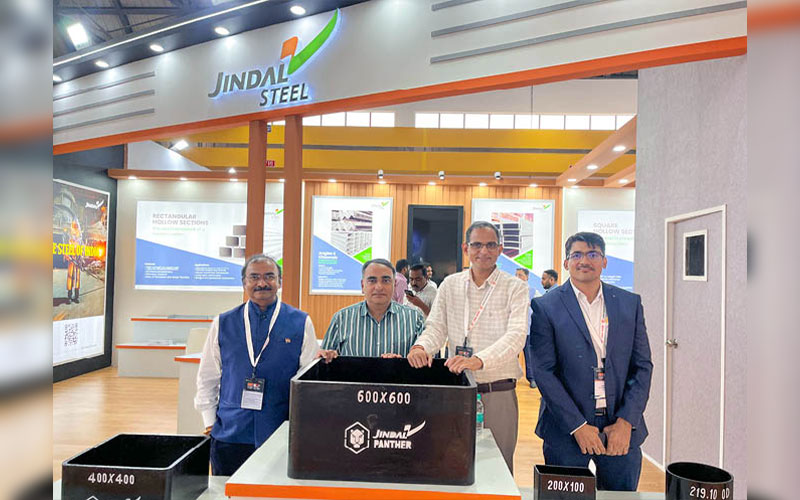
Narsingh Sura: Our product range includes circular hollow section (CHS) from 89 mm to 219 mm OD, while square hollow section (SHS) ranges from 60×60 mm to 600×600 mm. The 600×600 mm size is a key USP because we are manufacturing it through the ERW route and it is the first such plant in India. We have three mills at Raigarh– two based on Direct Forming Technology (DFT) and one semi-conventional mill. Our total capacity is 0.75 million tonnes per annum.
Our products find applications in airports, high-rise buildings, refineries, IOCL projects, railways and metros. Hollow sections are also being increasingly used in railway station development under the Amrit Bharat Station Scheme.
TPI: Could you elaborate on the production capacities of your tube and pipe product categories?
Paras Sharma: We have three mills. Two are DFT mills and one is conventional. Mill 3 has a capacity of 37,500 tonnes per month, while Mills 2 and 1 have capacities of 12,500 tonnes per month each. This gives us a total capacity of 62,500 tonnes per month.
TPI: Could you share your recent developments, innovations and strategic initiatives in the tube and pipe segment?
PS: We are the only company in India manufacturing the 600×600 series through the DFT route. We are also working on E450 and YST 410–450 grade tubes, in addition to YST 355. An important focus for us is to move the market from lower-strength products towards higher-strength products. We are not focusing on the YST 210 segment and are instead working towards developing and promoting higher-strength applications.
TPI: What is currently the biggest challenge facing the tube and pipe industry?
PS: Pricing remains a major challenge. There are many tube manufacturers who produce pipes from smaller billets and other semi-finished inputs, including through narrow rolling processes. For an integrated steel manufacturer that produces steel from iron ore through to finished products, the cost structure is different.
While this creates a pricing challenge, the quality of the integrated product is strong. Our objective is also to develop the tube and pipe business for the automotive segment and long-span structures, where smaller re-rollers or induction-furnace-based producers may not have the capability to meet the requirements.
The pricing challenge is particularly visible in conventional-grade applications such as water pipelines and distribution. However, we see greater opportunities in the photovoltaic and automotive segments.
TPI: How important are automation and digitalisation in your future growth plans? Which manufacturing or quality-control improvements have delivered measurable benefits?
Suresh Babu Jakkula: We are under continuous development of our products. The introduction of the 600×600 mm hollow section is an important development for us. These larger sizes have the potential to replace concrete in several structural applications. We see significant opportunities in building applications, including factories, houses, shopping malls and other engineered structures.
India is still developing in terms of steel consumption compared with developed countries, where steel is used extensively in construction. We have already initiated this transition, and we expect adoption to improve further over the coming years.
One of the key challenges is convincing customers to move from concrete to steel. Steel has the advantage of being reusable and recyclable, whereas concrete structures cannot be reused in the same manner. The industry, manufacturers and the Government of India are collectively promoting greater steel usage.
TPI: Looking ahead, where do you see the next major growth opportunities for the tube and pipe industry over the next three to five years?
SBJ: The biggest opportunity will be in photovoltaic and construction, particularly applications where steel can replace concrete. Developed markets such as Germany and other European countries have extensive use of steel structures. Steel offers advantages in terms of strength and recyclability, and there is considerable scope for India to increase its adoption of steel in construction.
Also Read: Tube & Pipe India Emagazine Jul-Sep Issue 2026
TPI: Lastly, what are your expectations from TPF Hyderabad and what opportunities do you see in the Indian market?
SBJ: The Indian market is very large, and there is significant scope for growth as India continues to increase its steel consumption. Platforms such as Tube & Pipe Fair Hyderabad help industry participants understand what is happening in the market, what customers require and what developments are taking place. Such interactions allow manufacturers to understand changing expectations and identify areas where products and technologies can be improved. We see this as an important opportunity to engage with the industry and work towards meeting evolving customer requirements.

The introduction of the 600×600 mm hollow section is an important development for us. These larger sizes have the potential to replace concrete in several structural applications. We see significant opportunities in building applications, including factories, houses, shopping malls and other engineered structures.