
As volatility in steel prices and raw material availability reshapes industry dynamics, manufacturers are reworking strategies to stay competitive and responsive. In an exclusive interaction with Tube & Pipe India, Mr. Utkarsh Bansal, Executive Director, Utkarsh India Limited, shares how the company is shifting toward agile manufacturing, flexible pricing models, and faster execution cycles to navigate uncertainty. He points to rising demand from solar, infrastructure, and power transmission sectors, alongside a growing preference for customized, application-specific solutions. On the capacity front, the company has recently commissioned a new mill with around 100,000 MTPA capacity for rectangular and square hollow sections and torque tubes.

Tube & Pipe India: How are the evolving steel dynamics– quality, pricing, availability– shaping your manufacturing strategy of steel pipes, tubes, and other products?
Utkarsh Bansal: The evolving dynamics of the steel industry—particularly in terms of pricing volatility, quality segmentation, and raw material availability—are significantly influencing our manufacturing and commercial strategies in the tube and pipe sector.
The increasing unpredictability in steel prices has made it challenging to commit to long-term fixed-price contracts. As a result, incorporating dynamic pricing mechanisms or price variation clauses has become essential to safeguard both manufacturers and customers against market fluctuations.
Additionally, recent developments such as the imposition of safeguard duties post December, coupled with geopolitical factors impacting HR coil availability, have led to a noticeable escalation in input costs. This has further reinforced the need for prudent procurement and flexible pricing strategies.
A key operational impact of this volatility is on inventory management. Maintaining high stock levels becomes inherently risky in a fluctuating price environment, as it exposes manufacturers to potential stock losses. Consequently, the focus is shifting towards faster rolling cycles and agile manufacturing. In today’s scenario, it is critical to be able to service project-based orders—which typically involve multiple sizes and specifications—within tight timelines without relying on large inventories.
This, in turn, necessitates continuous investment in mill capabilities—whether through capacity expansion, productivity enhancements, or faster transitions. The ability to switch sizes quickly and execute short rolling runs efficiently has become a key differentiator, enabling faster turnaround while mitigating inventory risks.
Another important trend is the widening gap between primary and secondary steel manufacturers. The cost differential is driving certain applications—particularly those with lower criticality—towards secondary materials. This is creating a bifurcation in the market, where price-sensitive segments are shifting, while quality-conscious customers continue to rely on primary-grade materials.
At Utkarsh India Limited, our strategy is to remain agile—balancing cost competitiveness with an unwavering commitment to quality, while aligning our manufacturing processes and product offerings with the evolving needs of the tube and pipe industry.
TPI: In the tube and pipe sector, how critical is steel quality in determining product performance, reliability, and end-use acceptance? How do you ensure the best quality of your pipes and tubes?
UB: Quality is paramount in the tube and pipe sector, given the critical applications these products serve—ranging from water and gas transportation to structural and infrastructure usage. The long-term performance, safety, and reliability of these applications are directly dependent on the quality of steel used and the manufacturing processes adopted. While certain segments have migrated towards secondary-grade materials due to cost considerations, customers prioritising durability, consistency, and lifecycle performance continue to place their trust in established brands like Utkarsh.
To ensure the highest quality standards, we follow a rigorous, multi-stage quality assurance process such as use of high-grade raw materials sourced from reputed primary producers such as Steel Authority of India Limited (SAIL); conducting stringent inspection at the raw material stage; advanced in-process testing, including Non-Destructive Testing (NDT), ultrasonic testing, and hydrostatic pressure testing; dimensional and mechanical property checks at various stages of production; final inspection and testing prior to dispatch.
In addition, we continuously invest in modernising our manufacturing and testing infrastructure, along with upgrading machinery to ensure precision, consistency, and compliance with evolving standards.
TPI: Which end-use sectors are currently driving demand for your steel products, and how is this influencing your portfolio?
UB: We are witnessing strong demand across sectors aligned with infrastructure development and energy transition. Key demand drivers include:
- Solar energy—both fixed tilt and tracker-based structures
- Power transmission and distribution—towers, poles, joists, and related structures for renewable energy evacuation
- Monopoles—driven by right-of-way (ROW) constraints in urban and semi-urban areas
- Road safety infrastructure—particularly crash barriers
- Pre-engineered buildings (PEB)—a rapidly growing segment and a strategic focus area for us
These trends are actively shaping our portfolio strategy. While we continue to strengthen our position in core segments such as pipes and tubes, we are simultaneously expanding into high-growth areas like solar structures, heavy engineering, and PEB solutions to create a diversified and future-ready product mix.
TPI: Are customers increasingly looking for application-specific steel products rather than standard offerings? If yes, how are you catering to the demand?
UB: Yes, there is a clear and growing shift towards application-specific and customised steel solutions. Customers today are seeking optimised designs tailored to their specific project requirements. For instance, in the (Pre-engineered buildings) PEB segment, clients increasingly demand customised structural solutions—ranging from pipe-based frameworks to hybrid designs.
Similarly, in segments such as monopoles and distribution poles, there is a noticeable move towards higher-grade steels like E350 and E410, enabling more efficient designs, weight optimisation, and enhanced performance. In solar applications as well, project developers are adopting highly customised designs using advanced materials such as ZAM (Zinc-Aluminium-Magnesium) and AZ coatings, along with varied specifications to improve durability and efficiency.
At Utkarsh, we have strengthened our design, engineering, and manufacturing capabilities to deliver such customised, application-driven solutions—ensuring both technical excellence and cost optimisation for our customers.
TPI: With turnkey solutions in the tube & pipe sector gaining traction, how do you view your business evolving in providing end-to-end solutions?
UB: We see significant opportunities in offering turnkey, end-to-end solutions and have been actively expanding in this direction.
We have developed in-house capabilities across design, detailing, manufacturing, and execution, enabling us to provide integrated solutions. For example manufacturing and installation of telecom towers using pipe structures for leading telecom operators, execution of solar carport projects on a turnkey basis, undertaking complete site development and installation responsibilities, delivering customised fabricated pipe-based structures across applications.
This integrated approach not only enhances value for our customers but also allows us to participate more deeply across the project lifecycle.
Another important trend is the widening gap between primary and secondary steel manufacturers. The cost differential is driving certain applications—particularly those with lower criticality—towards secondary materials. This is creating a bifurcation in the market, where price-sensitive segments are shifting, while quality-conscious customers continue to rely on primary-grade materials.
TPI: Does offering a wider range of turnkey solutions provide a competitive edge, or does it add operational complexity?
UB: Offering turnkey solutions undoubtedly provides a strong competitive edge, especially in a highly competitive and fragmented market. Not many players have the capability or willingness to deliver end-to-end solutions, which allows us to differentiate ourselves meaningfully.
While it does introduce additional operational complexity—particularly in project management, coordination, and execution—this is effectively manageable through the right organisational structure, experienced teams, and robust systems. In our view, the benefits in terms of customer stickiness, value addition, and market positioning far outweigh the associated complexities.
TPI: How do you ensure consistency and quality across your diversified product portfolio?
UB: Consistency in quality across a diversified portfolio is achieved through a disciplined, system-driven approach. Our key focus areas include- sourcing from reliable and reputable raw material suppliers, maintaining uniform quality standards across all customers, without any dual benchmarks, implementing stringent quality assurance and quality control (QA/QC) systems at every stage, ensuring that quality processes are system-driven rather than being dependent on individual discretion, investing in modern testing facilities and regular upgradation of manufacturing infrastructure and deploying trained and accountable personnel across all stages of production and inspection
This integrated approach ensures that every product leaving our facilities adheres to the same high standards of quality and reliability.
Also Read: Satyam Pipes: Building Strength with Precision and Vision
TPI: Going forward, will growth be driven more by scale in core products or by diversification into specialised steel applications?
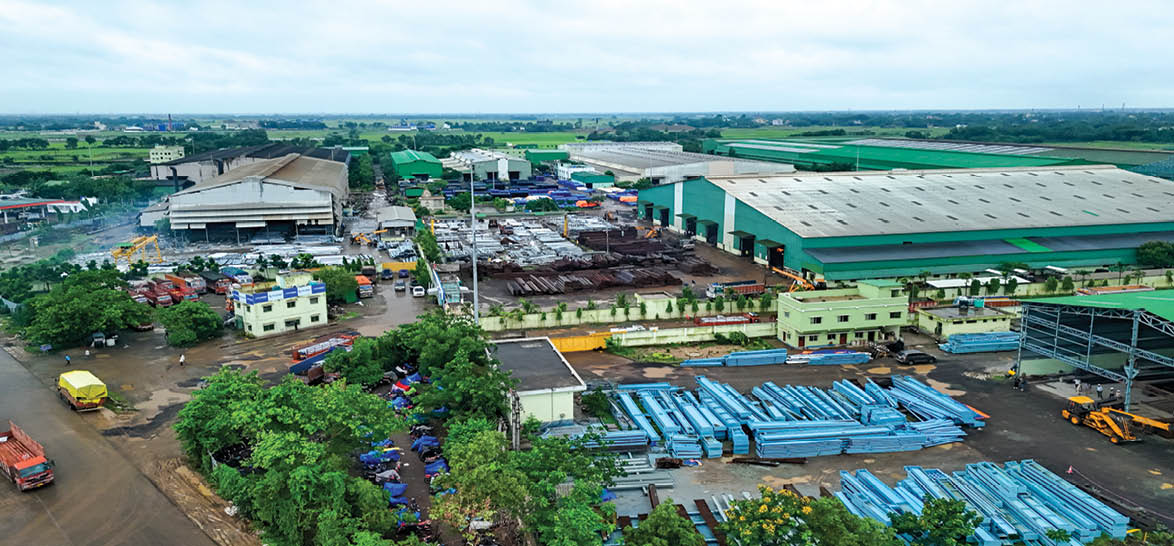
UB: Our growth strategy will follow a balanced, dual-pronged approach—driven by both scale and diversification. On the core side, we are continuing to expand capacities. Recently, we commissioned a new mill with a capacity of approximately 100,000 MTPA for rectangular and square hollow sections and torque tubes. We have also enhanced capacities in key segments such as polygonal poles, crash barriers, and transmission towers.
At the same time, we are actively diversifying into specialised and high-growth segments such as solar structures, pre-engineered buildings, and heavy engineering structures. This balanced approach allows us to drive volume growth while also building a resilient and future-ready portfolio aligned with emerging industry trends.