
Akash Steel Crafts Pvt. Ltd. is strengthening its focus on industrial applications with a broad range of stainless steel pipes and tubes designed for demanding sectors such as oil and gas, pharmaceuticals, dairy, data centres, wastewater and irrigation. With capabilities spanning large diameters and heavy wall thicknesses, the company is also investing in automation, specialised machinery and capacity expansion to address evolving industrial requirements. In an exclusive interview with Tube & Pipe India, Mr. Akash Mohan, CEO, Akash Steel Crafts Pvt. Ltd., discusses the company’s product portfolio, manufacturing capabilities, technology investments, expansion plans and approach to emerging market opportunities.
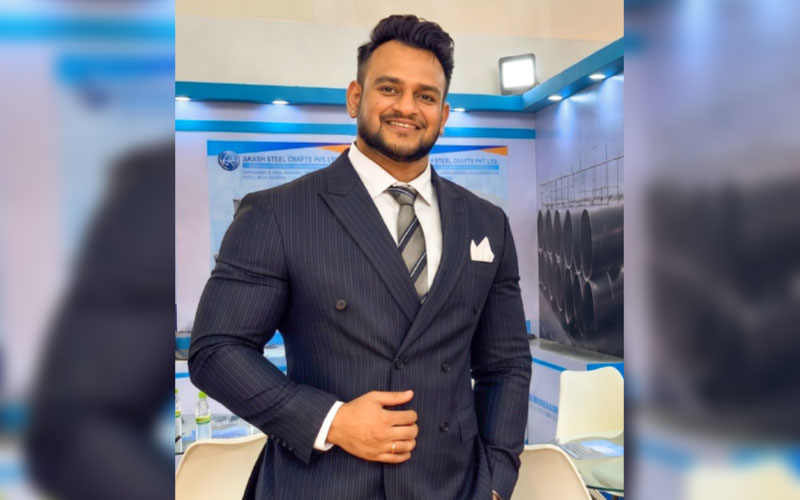
Tube & Pipe India: Could you briefly introduce your product portfolio and the end-use sectors it caters to?
Akash Mohan: Akash Steel Crafts is primarily engaged in the manufacturing of stainless steel pipes and tubes. Stainless steel is a capital-intensive product. For comparison, mild steel costs around Rs. 60 per kg, whereas stainless steel is approximately Rs. 280-290 per kg in the finished-product form. Our product range starts from ½-inch NB and goes all the way up to 200 inches. Essentially, if it is stainless steel, we manufacture it.
While pipes are used across many applications, we are more focused on industrial applications. We primarily cater to the oil and gas, pharmaceutical and dairy sectors. We are also seeing huge demand for stainless steel pipes from the data centre industry. Data centres consume a significant amount of power, and their cooling systems use stainless steel.
We have also entered the wastewater industry, with wastewater and irrigation emerging as areas of opportunity. Automotive is another sector where stainless steel pipes are used, although we do not currently cater to the automotive industry because our pipes are focused more on heavier thicknesses. Our pipe thickness starts from 2 mm and goes up to 25-30 mm.
TPI: What are your production capacities across your product portfolio?
AM: We have two departments– fabrication and milling. Our tube mill has a capacity of up to 200 tonnes per month, while our fabrication division can produce at least 250 tonnes per month. We consider 250 tonnes as an important benchmark for the fabrication division, and achieving that level is essential for the business.
TPI: What are some of the innovations, product developments or investments, including capacity expansion, that you would like to share?
AM: This is something I have seen my father practise, and I try to follow the same approach. Every month, when you come into our company, we are innovating a particular manufacturing process and trying to make it better, faster or more efficient. One example is automation. Earlier, pipes were rolled and then welded manually. Over the past five years, we have eliminated the need for manual welding in this particular process, and it is now being done automatically by a machine.
Manual welding exposes workers to intense heat, with the welding process reaching temperatures of around 2,000°C. As a result, a welder may need to take breaks and recover before continuing. By contrast, the automated process can operate continuously for up to 12 hours, helping improve production capacity and weld consistency.
As a result, production capacity increases and weld quality improves. As a manufacturer of welded pipes, welding is extremely important to us because our entire value proposition depends on the quality of the weld.
We have also entered the wastewater industry, with wastewater and irrigation emerging as areas of opportunity. Automotive is another sector where stainless steel pipes are used, although we do not currently cater to the automotive industry because our pipes are focused more on heavier thicknesses. Our pipe thickness starts from 2 mm and goes up to 25-30 mm.
TPI: Are there any other recent investments or technology developments?
AM: In the past year, we purchased a three-roll bending machine. We also developed a custom-made six-metre machine, whereas these machines are typically available in two- or three-metre configurations. The machine is used for bending large plates into round shapes to manufacture big pipes. It essentially rolls the plate into a cylindrical form. Very few people in the industry have undertaken a six-metre version, but this was developed according to our specific requirement.
TPI: Could you share the upcoming expansion plans of the company?
AM: We have started our expansion plans. Our current production capacity is around 500 tonnes, we are planning to increase it to 700 tonnes by the end of 2027. As part of this expansion, we are constructing a three-floor shed and have purchased a new tube mill with capacity up to 14 inches. We have also started another factory very close to our existing facility and have installed machines there as well. All these projects are progressing together, and I am very optimistic that they will help us achieve the production figures we are targeting.
TPI: What are the key challenges and trends that you are seeing in the stainless steel pipe and tube industry today?
AM: The biggest challenge is China. To explain this through an example, we buy raw material from Jindal and manufacture it into pipes in India. If Jindal supplies the raw material at Rs. 150 per kg, we may sell the finished pipe in India at around Rs. 180 per kg.
However, over the past five to six years, traders have increasingly started importing finished products from China. If those products are imported at around Rs. 150 per kg and sold at Rs. 160 per kg in India, it becomes difficult for Indian manufacturers to compete. As a result, bulk orders often go to Chinese suppliers, while Indian manufacturers receive the remaining orders. We also face pricing pressure, and margins have reduced drastically.
TPI: How have you responded to this competitive pressure?
AM: My father identified this trend quite early. Instead of focusing on smaller sizes, we decided to focus on larger-diameter pipes. The logic is that a 40-foot container can accommodate a large number of smaller pipes, making imports more economical. However, only a few large pipes can fit into the same container. This makes importing large-diameter pipes less economical and creates an opportunity for domestic manufacturers.
That is why we started focusing on large-diameter manufacturing. Of course, we cannot say there will never be a challenge in this segment, but currently this strategy has helped us create a market. Jindal also helps us manage our margins, and we are managing the situation as best as possible.
TPI: What industry trends do you see emerging in the coming years?
AM: One major trend is forward and backward integration. Companies that traditionally manufactured coils are now also entering pipe manufacturing. We are seeing this with companies such as Jindal Steel and Jindal Stainless. My vision is also focused on forward integration. Ten years from now, I want to continue making pipes, but I would also like to look at what comes next for the pipe and potentially manufacture products or systems that use our pipes.
I do not see much opportunity in backward integration because there are already many coil manufacturers. Instead, I would rather establish a separate special-projects division within Akash Steel Crafts that could move into EPC contracting. One area I have been considering is cooling systems, where the raw material or piping component would be based on the pipes we manufacture.
Also Read: Tube & Pipe India Emagazine Jul-Sep Issue 2026
TPI: How has your experience been at TPF Hyderabad, and what are you looking forward to?
AM: I would say it has been 50-50 so far. Our aim is to connect with potential clients and see how many of those discussions eventually materialise into business opportunities.
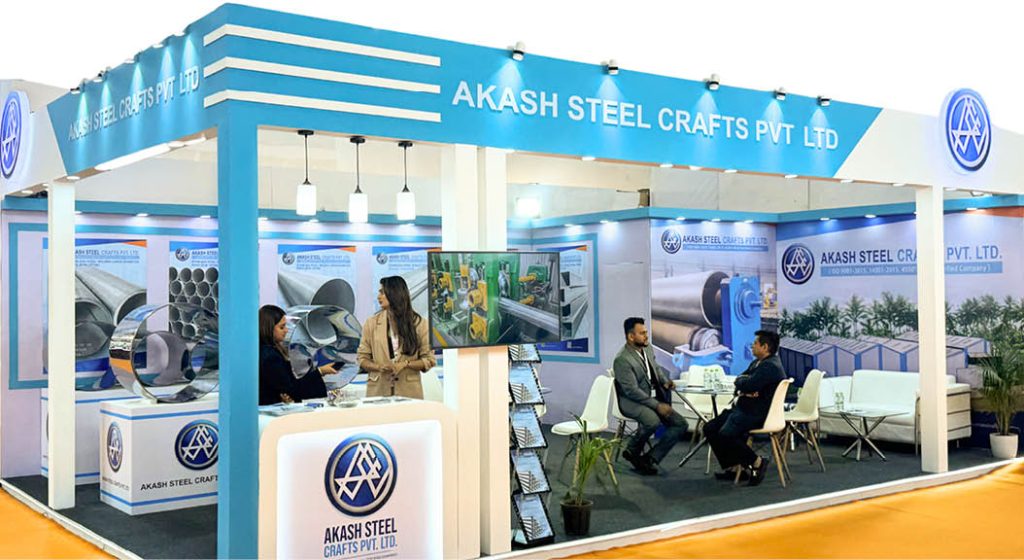
At the same time, exhibitions are important for brand visibility. We have been exhibiting for around four years, and we have seen other exhibitors and peers returning as well. When people come to these exhibitions and repeatedly see your brand, it stays in their minds subconsciously and can help with future business.
I look at these exhibitions almost like social gatherings for a particular industry or niche, where everyone from the industry comes together. This is our second TPF exhibition. My sister and wife have also joined the company and are now involved in different areas. We might also participate in the Delhi Edition in the future. Delhi as a region is yet to be explored, while Hyderabad has been our first time because of it’s location and access to the South Indian market.
My vision is also focused on forward integration. Ten years from now, I want to continue making pipes, but I would also like to look at what comes next for the pipe and potentially manufacture products or systems that use our pipes.