
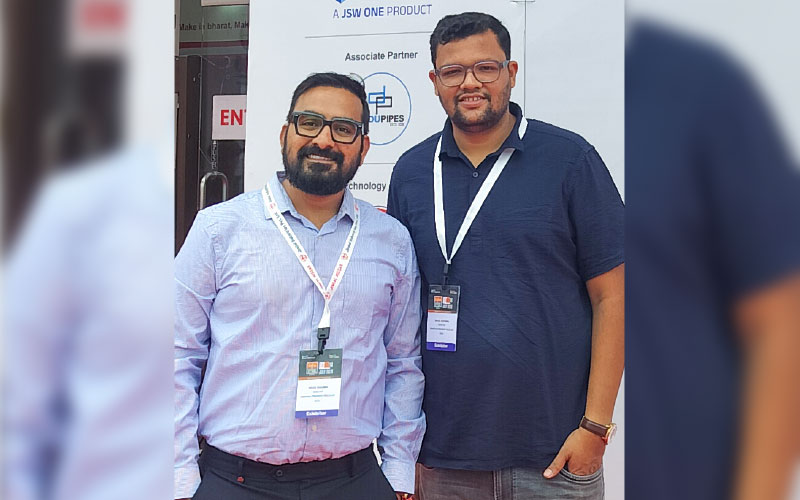
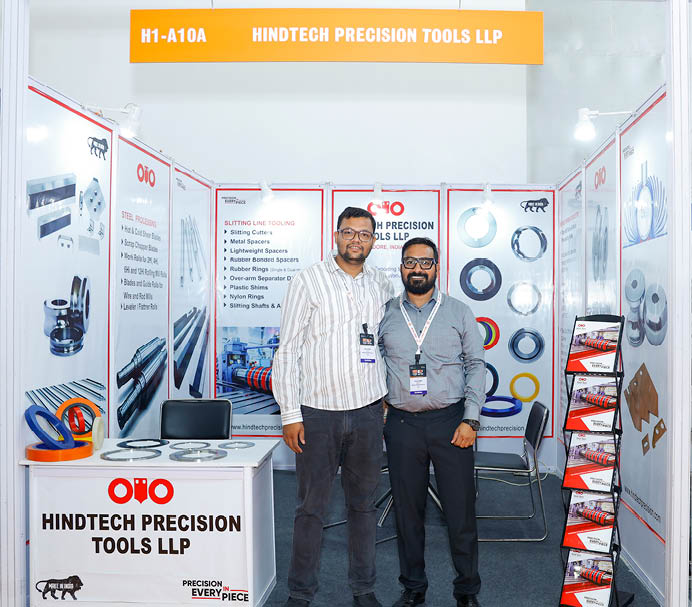
HindTech Precision Tools LLP showcased its precision-engineered tooling solutions for the tube and pipe, steel processing and metal forming industries at TPF Hyderabad 2026. The company presented tube mill rolls, slitting cutters, spacers, separator discs and other critical tooling components, highlighting its focus on accuracy, durability and extended service life. In an exclusive interview with Tube & Pipe India, Mr. Vikas Sharma and Mr. Vikas Agrawal, Directors, HindTech Precision Tools LLP, discuss the company’s precision-engineered tooling solutions, evolving customer requirements, technology upgrades and the growing role of automation in tube and pipe manufacturing. They also share HindTech’s objectives from participating in TPF Hyderabad, including engaging directly with tube and pipe manufacturers, understanding evolving application requirements, exploring new business opportunities and building industry collaborations.
Tube & Pipe India: Please briefly introduce your company and the technologies or solutions you are showcasing at TPF Hyderabad.
Vikas Sharma: HindTech Precision Tools LLP is an Indian manufacturer and exporter of high-precision tooling solutions for the tube and pipe, steel processing, and metal forming industries. We specialise in tube mill rolls (tube forming rolls) and slitting line tooling, serving customers across more than 25 countries with products engineered for accuracy, durability, consistency, and extended service life.
At Tube & Pipe Fair Hyderabad 2026, we showcased our range of precision-engineered tooling solutions, including tube mill rolls, slitting cutters, metal spacers, rubber bonded spacers, separator discs, and other critical tooling components used in tube manufacturing and steel slitting operations.
Our approach is centered on understanding the customer’s application and manufacturing requirements and then delivering tooling with the appropriate material, heat treatment, geometry, surface finish, and dimensional accuracy. This enables our customers to achieve stable production, consistent product quality, longer tooling life, and reduced downtime. We are increasingly positioning ourselves as a precision tooling partner rather than simply a component manufacturer, supporting customers with customized solutions for demanding production environments.
TPI: What are customers currently prioritising most when investing in new equipment or upgrading existing facilities?
Vikas Agrawal: Customers today are evaluating investments from a much broader perspective than the initial purchase price. Their primary focus is on total cost of ownership, production reliability, tooling life, dimensional consistency, and return on investment. Higher production speeds are important, but customers also want to maintain product quality at those speeds while reducing setup time, scrap, unplanned downtime, and maintenance requirements. This is creating greater demand for precision tooling capable of maintaining consistent performance throughout its operating life.
We are also seeing customers place greater importance on supplier capability. They increasingly prefer partners who can provide application-specific customization, reliable quality, technical support, shorter lead times, and responsive after-sales service.
For tooling in particular, the focus is moving towards achieving a lower overall cost per tonne rather than simply obtaining the lowest initial tooling cost. A tool that delivers longer life and stable performance can provide significantly greater value over the complete production cycle.
TPI: Which areas of tube and pipe manufacturing are seeing the highest demand for technology upgrades today?
VS: We are seeing strong demand for technology upgrades across tube mill forming sections, slitting lines, roll forming systems, and finishing operations. Manufacturers are looking to increase throughput while maintaining tighter dimensional tolerances, better surface finish, and consistent product geometry. From our perspective, tube mill rolls and slitting line tooling are particularly important areas of focus. As production speeds increase and manufacturers process thinner gauges, higher-strength steels, and more demanding material grades, tooling accuracy and wear resistance become increasingly critical.
In slitting operations, customers are looking for improved cutting performance, longer knife life, better strip-edge quality, and reduced setup losses. Similarly, in tube mills, precision forming rolls with consistent geometry and surface finish are essential for maintaining stable forming conditions and minimizing downstream corrections. Overall, the industry is moving towards tooling and process solutions that can support higher speeds, tighter tolerances, lower scrap, and more predictable production performance.

Our approach is centered on understanding the customer’s application and manufacturing requirements and then delivering tooling with the appropriate material, heat treatment, geometry, surface finish, and dimensional accuracy. This enables our customers to achieve stable production, consistent product quality, longer tooling life, and reduced downtime.
TPI: How are automation and digital technologies changing the way tube and pipe plants operate?
VA: Automation and digital technologies are gradually transforming tube and pipe manufacturing from largely machine-centric operations into more connected, monitored, and data-driven production environments.
Modern plants are increasingly adopting automated material handling, CNC-based production, real-time machine monitoring, process data collection, predictive maintenance, and automated quality-control systems. These technologies help manufacturers identify process deviations earlier, reduce operator dependency, improve machine utilization, and make maintenance more proactive.
The impact is also being felt in tooling. As production systems become more automated, there is less tolerance for variation in tooling performance. Rolls, cutters, spacers, and other tooling components must maintain highly consistent dimensions and performance because even a small deviation can affect an automated production process.
In our view, automation therefore increases the importance of precision, repeatability, traceability, and consistency in tooling manufacturing. The future will not only be about automating machines but also about creating a more predictable and measurable manufacturing ecosystem around them.
TPI: Are customers focusing more on greenfield projects or brownfield modernisation? What trends are you observing?
VS: We are seeing healthy activity in both segments, although brownfield modernization currently represents a significant area of opportunity. Many established manufacturers are choosing to upgrade existing production lines rather than replace complete plants. By improving tooling, automation, process controls, and critical equipment, they can increase capacity and productivity without undertaking the capital expenditure and longer implementation timelines associated with a completely new facility.
This is particularly relevant for tooling manufacturers because even an existing tube mill or slitting line can achieve meaningful performance improvements through upgraded and application-specific tooling.
At the same time, India continues to see new greenfield investments driven by infrastructure development, automotive and engineering applications, renewable energy, construction, and the broader expansion of domestic manufacturing. These projects offer opportunities to integrate modern equipment and tooling right from the initial plant design stage.
We therefore expect a dual growth pattern—brownfield projects focused on modernization and capacity enhancement, alongside greenfield projects designed around new-generation manufacturing technologies.
TPI: Looking ahead, which technologies do you believe will have the greatest impact on the tube and pipe industry over the next few years?
VA: We believe the greatest impact will come from the convergence of automation, Industry 4.0, artificial intelligence, predictive maintenance, advanced CNC manufacturing, digital quality control, and real-time process monitoring. These technologies will enable manufacturers to better understand production behaviour, identify deviations before they become quality issues, optimize maintenance intervals, reduce material wastage, and improve overall equipment utilization. Digital integration will also make it easier to track production and quality data across the manufacturing process.
At the tooling level, we expect continued development in advanced tool materials, heat treatment, surface engineering, wear-resistant coatings, precision grinding, and manufacturing technologies. As tube mills and slitting lines operate at higher speeds and handle increasingly demanding steel grades, the performance limits of conventional tooling will continue to be challenged.
The competitive advantage will increasingly come from combining advanced manufacturing technology with high-performance tooling. Longer tool life, tighter tolerances, predictable performance, and reduced tool-change frequency will become increasingly important contributors to the overall economics of tube and pipe production.
Also Read: Tube & Pipe India Emagazine Jul-Sep Issue 2026
TPI: What are your expectations from TPF Hyderabad 2026, and what opportunities do you see in the Indian market?
VS: Tube & Pipe Fair Hyderabad 2026 provided an excellent platform for us to interact directly with tube and pipe manufacturers, steel processors, technology providers, and industry professionals from India and overseas. For HindTech, the exhibition was not only an opportunity to showcase our products but also to understand evolving customer requirements, discuss application-specific challenges, and identify new areas for collaboration.
We see significant long-term opportunities in the Indian market. India’s continued investment in infrastructure, automotive, renewable energy, construction, engineering, and manufacturing is creating strong demand for tubes, pipes, and processed steel products. At the same time, Indian manufacturers are increasingly focused on improving productivity and achieving international quality standards to compete in global markets. This creates a growing requirement for reliable, precision-engineered tooling that can support higher production speeds, better dimensional control, and longer operating life.
At HindTech Precision Tools LLP, our objective is to leverage our manufacturing capabilities and international experience to support this growth. We aim to build long-term relationships with tube mills and steel processors by providing precision tube mill rolls and slitting line tooling tailored to their specific applications and production requirements.
We see India not only as a strong domestic market, but also as an increasingly important global manufacturing hub. Our long-term vision is to strengthen HindTech’s position as a trusted Indian manufacturer and global supplier of precision tooling solutions, delivering international-standard products with the flexibility, responsiveness, and technical understanding that modern manufacturers require.
Manufacturers are looking to increase throughput while maintaining tighter dimensional tolerances, better surface finish, and consistent product geometry. From our perspective, tube mill rolls and slitting line tooling are particularly important areas of focus.